.svg)
Eliminating ladder use in highway maintenance is not simply a safety aspiration, it is a regulatory obligation, an operational efficiency gain, and a measurable reduction in organisational risk. For traffic management contractors and local authorities responsible for highway works, ladders remain the single most preventable source of working at height exposure.
Where a ground level alternative exists, the Work at Height Regulations 2005 require its consideration, and where it is reasonably practicable, its use. The question for the industry is no longer whether to eliminate ladder use for specific tasks, but how quickly that elimination can be achieved.
Why Ladders Are the Leading Risk in Highway Maintenance
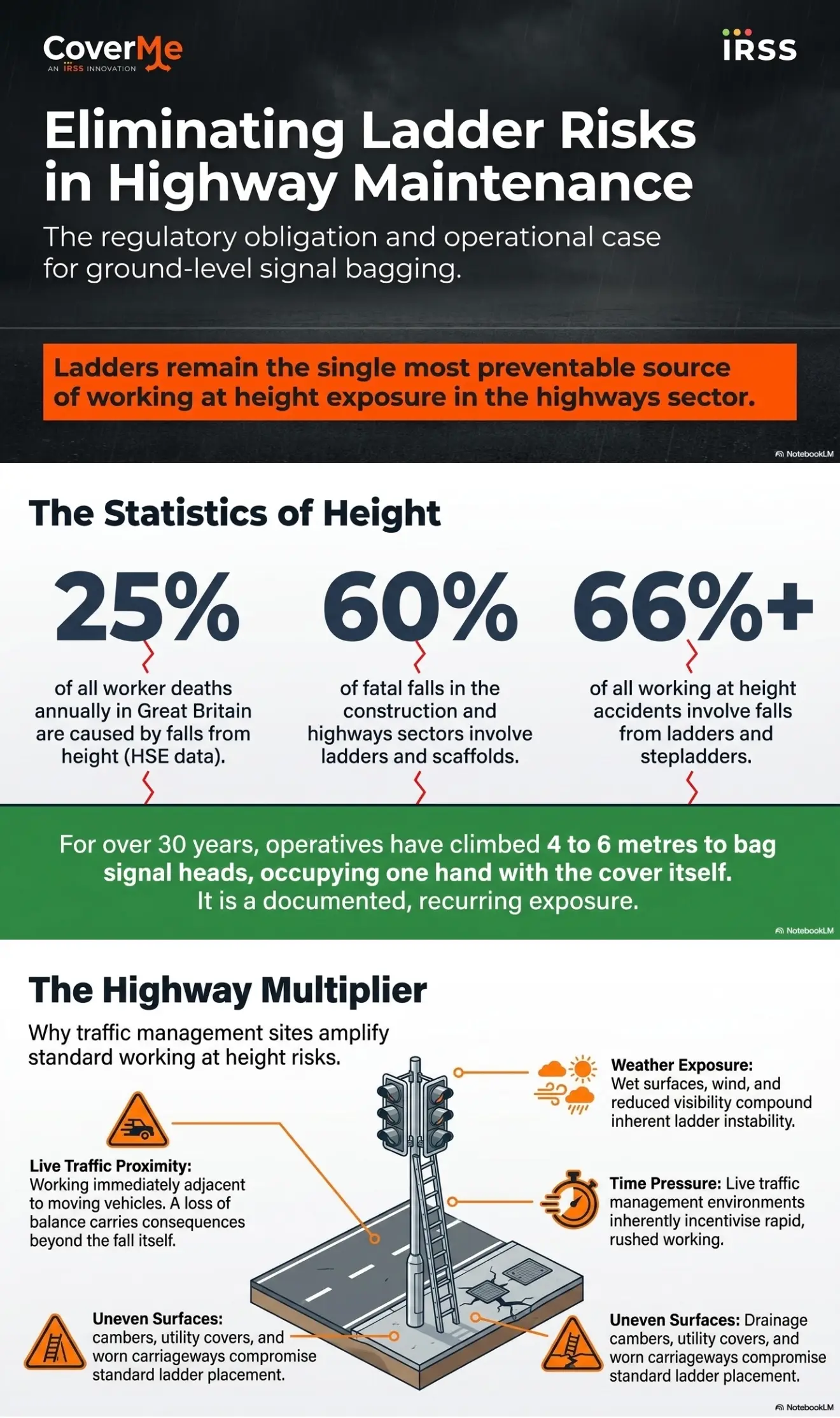
Ladders are involved in the majority of working at height incidents across UK industries. According to HSE data, falls from height remain the leading cause of fatal injuries in Great Britain, accounting for over 25% of all worker deaths annually. In the construction and highways sectors specifically, ladders and scaffolds are implicated in approximately 60% of fatal falls. Over two thirds of working at height accidents overall involve falls from ladders and stepladders.
In highway maintenance, the conditions that make ladder use particularly hazardous include:
- Live traffic proximity. Unlike a building site, operatives using ladders during highway maintenance are often working immediately adjacent to moving vehicles. A loss of balance, equipment slip, or unexpected movement carries consequences beyond the fall itself.
- Uneven and variable surfaces. Carriageway and footway surfaces are rarely ideal for ladder placement. Drainage cambers, utility covers, and worn surfaces all affect stability in ways that a controlled indoor environment does not.
- Weather exposure. UK conditions, wet surfaces, wind, reduced visibility , compound the inherent instability of ladder use on public roads.
- Time pressure. On live traffic management sites, there is an operational incentive to work quickly. Time pressure and ladder safety are a poor combination.
For signal bagging specifically, the most frequently repeated ladder task in traffic management, operatives climb to between 4 and 6 metres above ground level to cover each signal head, with one hand often occupied by the cover itself. This is not a theoretical risk. It is a documented, recurring exposure that has persisted for over 30 years because no alternative existed. Until now.
What Elimination Actually Means Under the Regulations
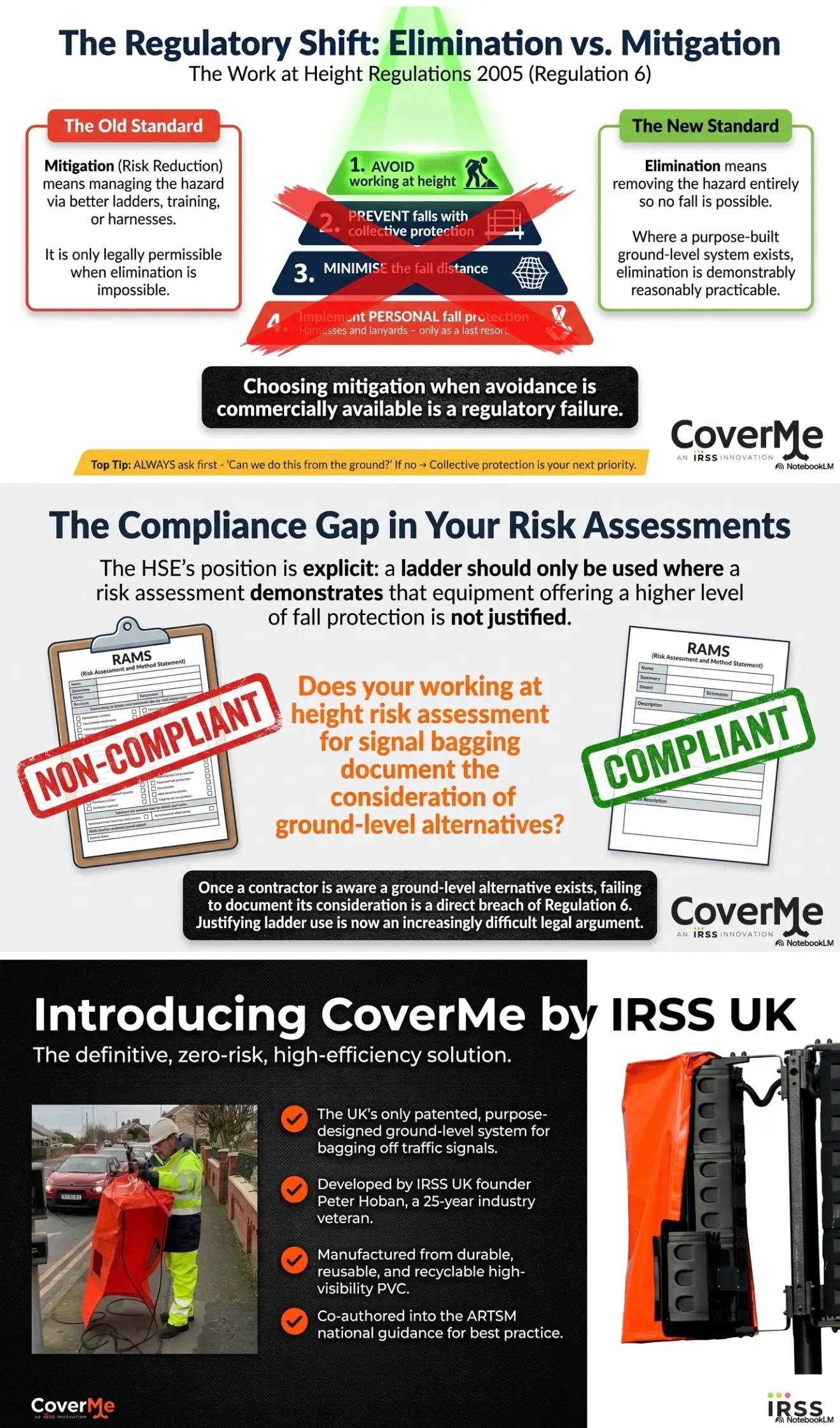
The Work at Height Regulations 2005 establish a hierarchy of control under Regulation 6. The first and highest level of that hierarchy is avoidance: where it is reasonably practicable to avoid working at height altogether, employers must do so.
Elimination is not the same as risk reduction. It does not mean managing the risk more carefully, providing better training, or using a more stable ladder. It means removing the hazard entirely so that no fall is possible. For signal bagging, where a purpose-built ground-level system is now commercially available, in widespread use, and competitively priced, elimination is demonstrably reasonably practicable.
This has direct consequences for risk assessments. Any contractor whose working at height risk assessment for signal bagging does not document the consideration of ground-level alternatives is not completing a compliant risk assessment under the Regulations. The HSE’s position is explicit: a ladder should only be used where a risk assessment has demonstrated that equipment offering a higher level of fall protection is not justified. Once a contractor is aware that a ground-level alternative exists, that justification must be made, and it is an increasingly difficult argument to sustain.
For a comprehensive overview of the full regulatory framework governing working at height in traffic management, including CDM 2015, the Red Book, and ARTSM guidance, see our pillar guide: Working at Height in Traffic Management: Risks, Regulations, and Safer Alternatives.
The Operational Case for Elimination
Beyond compliance, eliminating ladder use in highway maintenance delivers measurable operational benefits that compound across a contractor’s entire operation.
Faster Site Setup
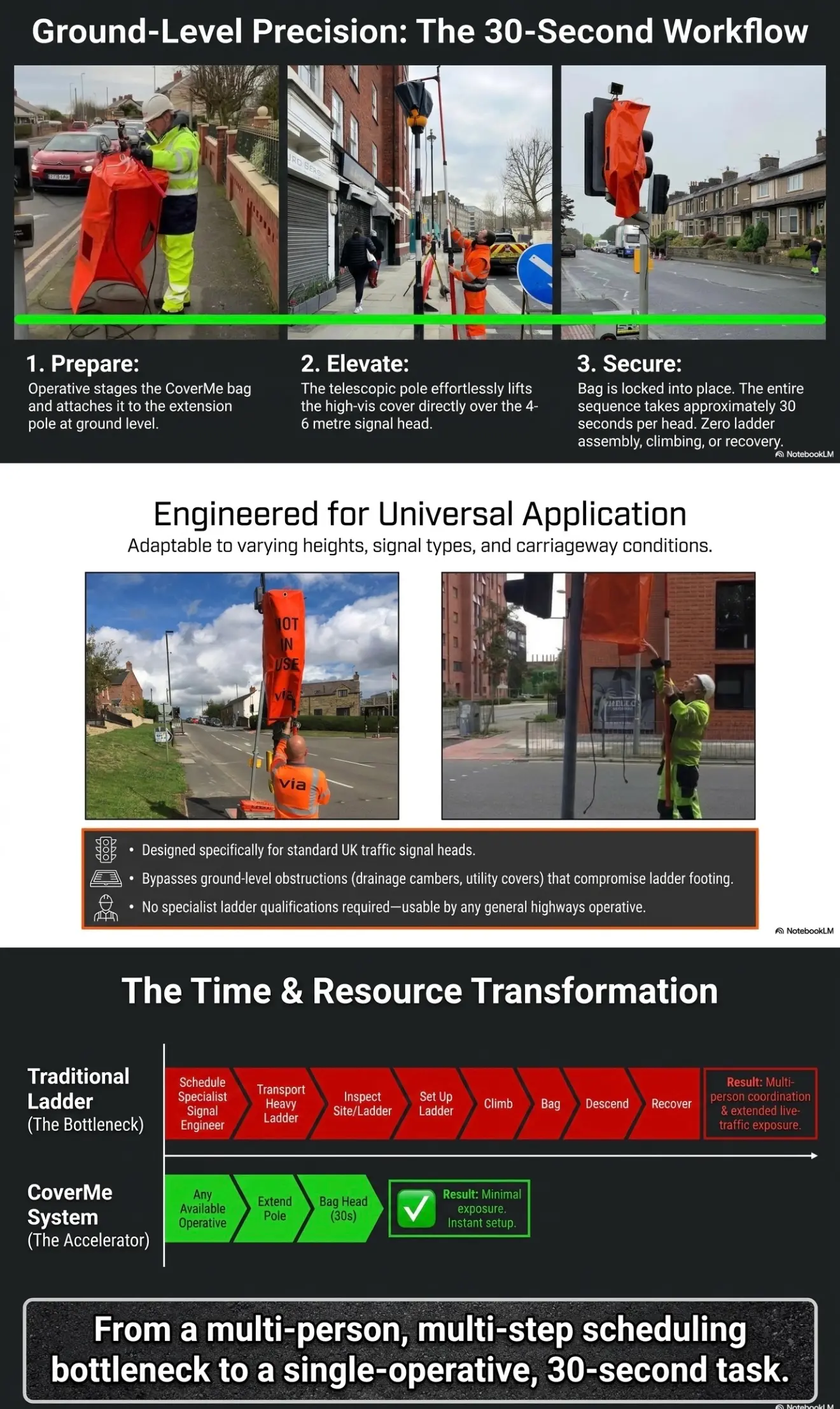
Traditional signal bagging requires a specialist signal engineer to attend site, access the signal cabinet, switch off the signals, and then climb and bag each head individually. On a multi-arm junction, this can involve a significant number of climbs and descents before temporary traffic management can be activated and works can begin.
With the CoverMe system from IRSS UK, each signal head is bagged in approximately 30 seconds from ground level using an extension pole. No ladder is assembled, positioned, climbed, or recovered. The entire bagging sequence for a junction is reduced from a multi-person, multi-step process to a task that a single operative can complete in a fraction of the time.
Removal of Specialist Dependency
The traditional ladder-based bagging process requires operatives with ladder training, and, for cabinet access, trained signal engineers. This creates scheduling dependency: works cannot begin until a specialist is available. On emergency works or time-sensitive schemes, that dependency translates directly into delay and cost.
Eliminating the ladder from the bagging stage removes that dependency entirely. With the CoverMe system, any operative from the wider highways pool can bag off signals safely. Removing the ladder requirement allows operatives from the general workforce to undertake bagging with no specialist ladder qualification, a flexibility that has direct value on sites where resource availability is constrained.
Reduced Site Exposure Time
Every minute an operative spends in or adjacent to the carriageway is a minute of exposure to live traffic risk. The hierarchy of site safety in traffic management is not just about working at height, it is about minimising the total duration during which operatives are exposed on a live road. Faster bagging reduces that exposure window. Ground level working reduces physical vulnerability during the task. The combination, faster and safer, is the operational argument for elimination in a single sentence.
Reduced Training and Compliance Overhead
Ladder use in the workplace carries its own compliance obligations: pre-use inspections, documented training, equipment maintenance records, and risk assessment requirements. Eliminating ladder use for a defined category of task eliminates the associated compliance overhead for that task. For contractors managing large teams across multiple sites, removing ladders from the signal bagging workflow is a simplification that reduces administrative burden as well as physical risk.
Reduced Insurance and Liability Exposure
A working at height incident on a live highway site carries significant potential liability. HSE enforcement action following a ladder fall can result in unlimited fines for organisations and up to two years’ imprisonment for individuals where the breach involved their consent or neglect. Beyond enforcement, civil claims from injured operatives, increased insurance premiums, and reputational damage all follow a serious incident. Demonstrating that the organisation adopted the highest reasonably practicable level of control, elimination, is the most defensible position available.
What IRSS UK’s CoverMe System Delivers in Practice
The CoverMe system from IRSS UK is the only patented, purpose-designed ground-level system for bagging off traffic signal heads in the UK. It was developed by Peter Hoban , founder of IRSS UK and a 25-year veteran of the highways industry, specifically to eliminate working at height from the signal bagging task. IRSS was proud to be part of a working group, in developing ARTSM’s national guidance on bagging and switch off of signals, co authoring the best practice framework the industry now operates under.
In practical terms:
- Each signal head is installed in approximately 30 seconds from ground level
- No ladder is required at any stage of installation or removal
- Any trained operative can use the system, no specialist ladder qualification needed
- The covers are reusable, recyclable, and manufactured from high-visibility PVC
- The system has been adopted by SRL Traffic Systems, Siemens, Colas Group, and operators across the UK and Republic of Ireland
- On the Colas/SRL City Connect 3 deployment in Leeds, 12 permanent signals were bagged with zero working at height risk before temporary lights were activated
This is not theoretical safety improvement. It is elimination of the hazard, demonstrably achieved, on live UK highway sites.
.png)
Common Questions
Does eliminating ladder use mean we need to change our risk assessments?
Yes. Once a contractor is aware of a ground-level alternative for a working at height task, that alternative must be documented in the risk assessment. Failing to consider it is not a neutral omission, it is a gap in Regulation 6 compliance. Risk assessments for signal bagging should now explicitly address whether a ground-level system has been considered and, if not adopted, why.
Is the CoverMe system suitable for all traffic signal types in the UK?
The CoverMe range is designed for standard UK traffic signal heads and has been deployed across a wide range of junction types and infrastructure operators. For specific compatibility queries, the IRSS UK team can advise on requirements for your signal type and site conditions.
Can the savings from eliminating ladder use be quantified for procurement purposes?
Yes, across several dimensions: reduced specialist engineer call-out costs, reduced site setup time, elimination of ladder training and inspection overheads, reduction in insurance risk, and removal of the compliance cost of ladder use documentation. For contractors operating across multiple sites, these savings compound significantly.
Does eliminating ladder use affect RAMS and method statement requirements?
Positively. Adopting a ground-level bagging system simplifies the working at height section of RAMS documentation for signal bagging: instead of detailing ladder selection, positioning, securing, and fall mitigation controls, the method simply notes that the task is performed from ground level with no working at height exposure. This streamlines documentation and reduces the review burden for principal contractors.
The Direction of Travel for Highway Maintenance Safety
The highways industry is moving towards ground level working wherever technically achievable. ARTSM’s development of national guidance on signal bagging, with IRSS UK’s direct involvement, is part of that trajectory. Local authorities specifying traffic management contracts are increasingly in a position to require ground-level bagging as a contract condition. Traffic management companies that have already adopted CoverMe can demonstrate Regulation 6 compliance in their health and safety management systems with minimal additional documentation.
Eliminating ladder use is not a future aspiration for highway maintenance safety. For signal bagging, it is achievable today, with a system that is proven, commercially available, and already in use at scale across the UK.
For the complete picture on regulations, risks, and safer alternatives across all working at height scenarios in traffic management, visit our guide: Working at Height in Traffic Management: Risks, Regulations, and Safer Alternatives.
To find out more about the CoverMe system or to discuss your site requirements, contact the IRSS UK team.