.svg)
The Traffic Management Act 2004 (TMA 2004) is one of the most important pieces of legislation governing how roads are managed in the United Kingdom. If you work in traffic management, highways contracting, or local authority roads, this Act affects your daily work, whether you realise it or not. Yet the full text runs to seven parts and dozens of sections. This guide cuts through the complexity and explains what the TMA 2004 actually does, who it applies to, and what it means in practice on site.
What is the Traffic Management Act 2004?
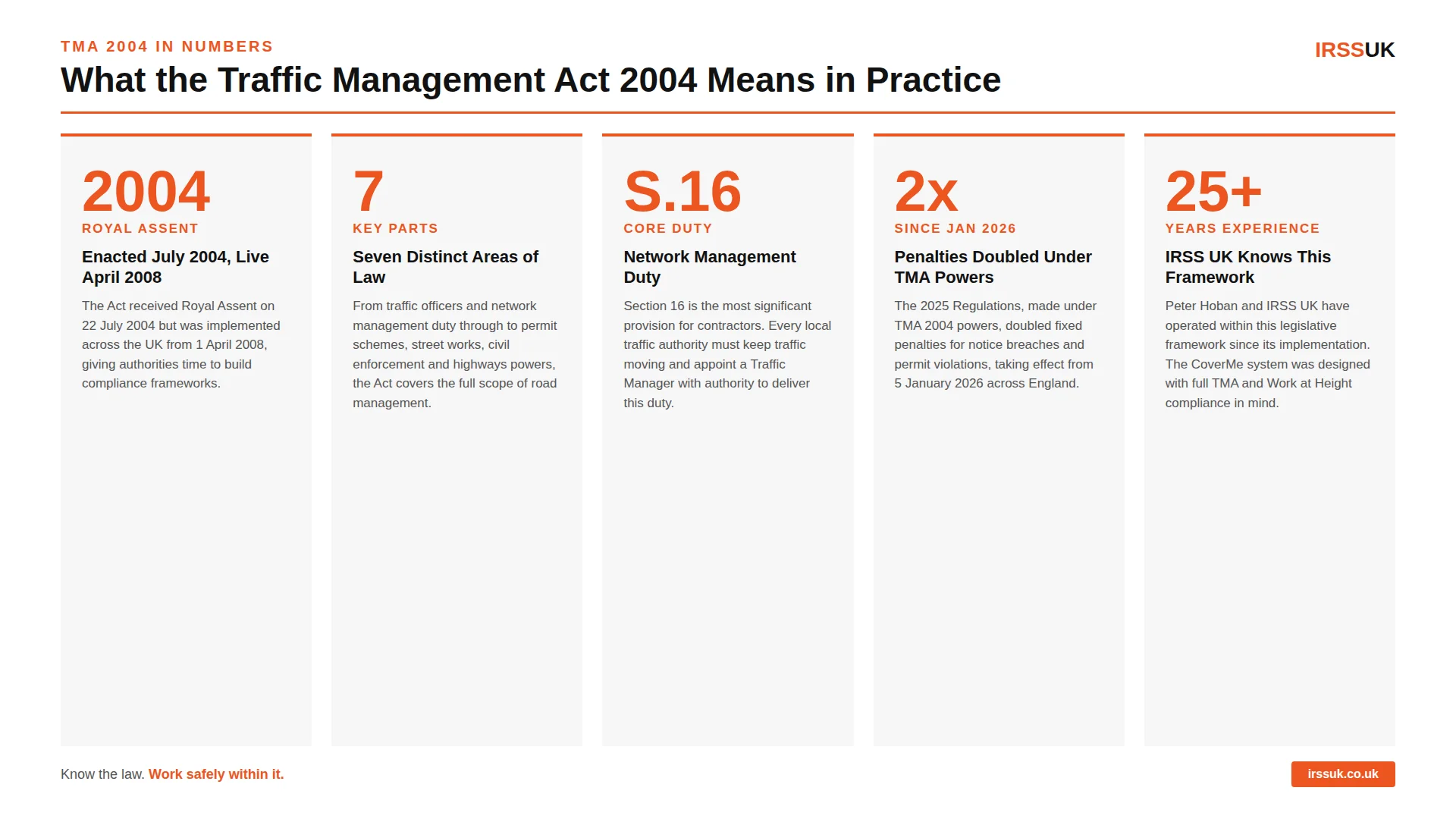
The Traffic Management Act 2004 is a UK Act of Parliament that received Royal Assent on 22 July 2004 and was fully implemented across England, Scotland and Wales from 1 April 2008. Its core purpose is to reduce congestion and minimise disruption on the road network by placing clear legal obligations on local traffic authorities, contractors, and utility companies.
Before the Act came into force, highway authorities had limited powers to coordinate or control the activities of those working on and under their roads. Street works by utility companies could be delayed, poorly coordinated, and prolonged without meaningful consequence. The TMA 2004 changed that by creating a robust regulatory framework with real enforcement teeth.
The Seven Parts: What Each One Covers
The Act is structured in seven parts, each dealing with a distinct area of road and traffic management.
Part 1 Traffic Officers. This part empowers the Secretary of State to designate uniformed traffic officers for the strategic road network — the motorways and trunk roads managed by National Highways. Traffic officers can stop and direct traffic, place temporary signs, and remove certain vehicles, but they are not police officers. Their role is specifically to manage the consequences of incidents, breakdowns and obstructions to restore traffic flow as quickly as possible.
Part 2 Network Management Duty. This is the most significant part for local authority highways teams and the contractors who work on their behalf. Section 16 places a statutory network management duty on every local traffic authority to manage their road network with a view to securing the expeditious movement of traffic. Authorities must also appoint a Traffic Manager — a named individual responsible for delivering this duty. Every permit, every set of works conditions, and every coordination decision a local authority makes is underpinned by this duty. If you are a contractor and an authority imposes tight working hours, a specific traffic management scheme, or restrictive permit conditions, Section 16 is most likely the reason.
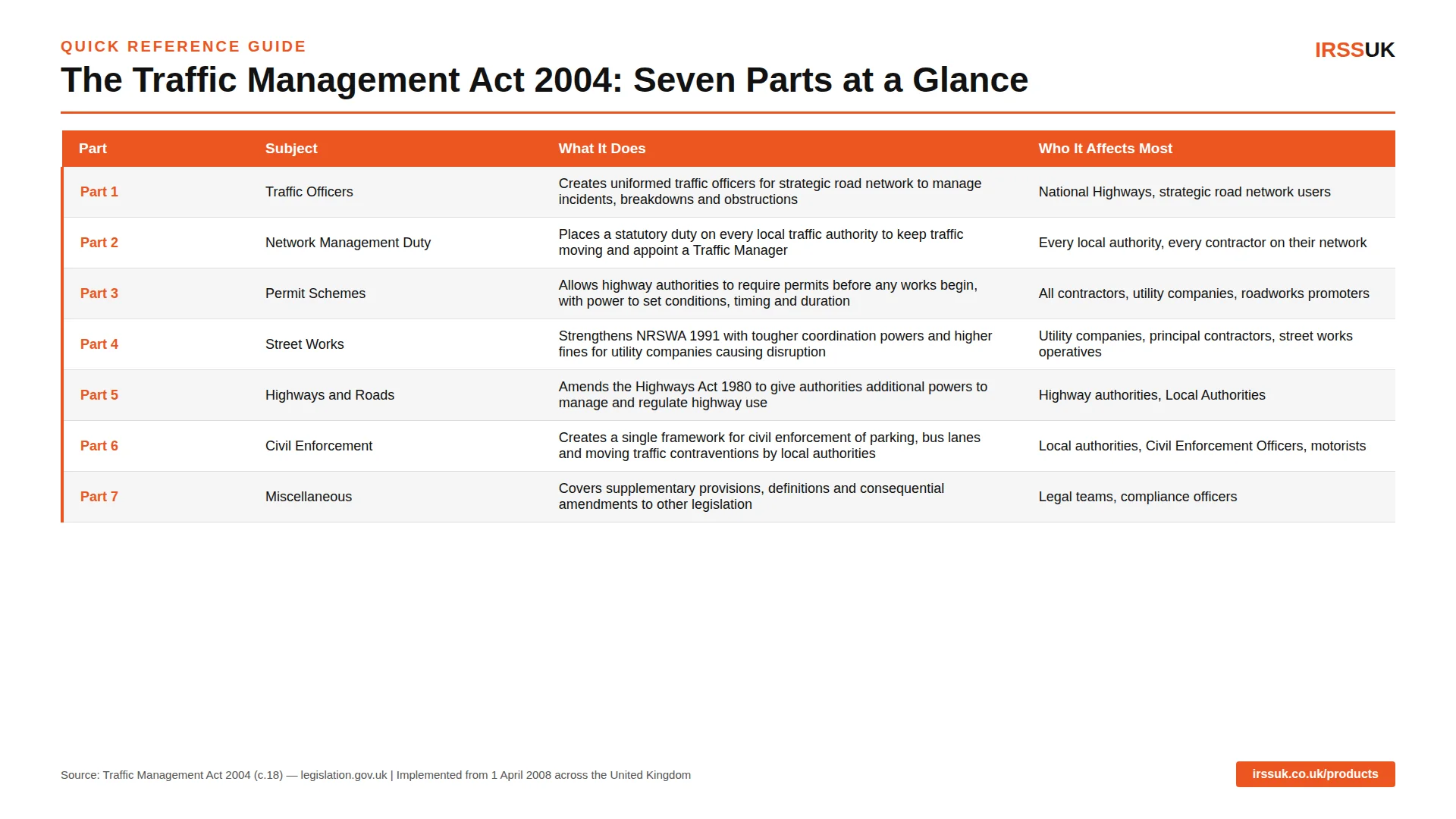
Part 3 Permit Schemes. Part 3 allows highway authorities to introduce permit schemes, requiring anyone intending to carry out works on the public highway to apply for and obtain a permit before work begins. Permit schemes give authorities the power to grant, refuse, or apply conditions to permits, controlling when work takes place, for how long, and how traffic is managed during it. As of 2026, the majority of local highway authorities in England operate some form of permit scheme. Failing to obtain a permit, or breaching permit conditions, results in financial penalties, which have doubled since January 2026 under the Street and Road Works (Charges and Penalties) (Amendments) (England) Regulations 2025.
Part 4 Street Works. Part 4 strengthens the regulatory framework of the New Roads and Street Works Act 1991 (NRSWA). It gives authorities more power to coordinate, control and direct works effectively, raises the levels of fines for utility companies who commit street works offences, and tightens the rules around notice and reinstatement. In practical terms, Part 4 is what gives highway authorities the ability to issue Fixed Penalty Notices to utility companies who fail to give adequate notice, overrun their permitted timeframe, or leave reinstatement in poor condition.
Part 5 Highways and Roads. Part 5 makes amendments to the Highways Act 1980, giving authorities additional powers to regulate and manage highway use. This includes provisions around highway works and the Secretary of State’s land acquisition powers for traffic management purposes.
Part 6 Civil Enforcement. Part 6 created a single, unified framework for the civil enforcement of traffic contraventions across England. It replaced the fragmented system that existed before and brought parking, bus lane, and some moving traffic enforcement together under one legal structure. Under Part 6, Parking Attendants became Civil Enforcement Officers (CEOs), and decriminalised parking enforcement formally became Civil Parking Enforcement (CPE). If you have ever received a Penalty Charge Notice, from a parking warden or a camera, Part 6 is the legislation that authorises it.
Part 7 Miscellaneous. Part 7 covers supplementary provisions, definitions, and consequential amendments to other legislation. It also amends Section 55 of the Road Traffic Regulation Act 1984, expanding the scope of local authority on-street parking accounts to include all civil enforcement income and expenditure.
What Section 16 Means for Contractors
Section 16 the network management duty — is the provision contractors feel most directly on live schemes. When a local authority imposes conditions on your permit, restricts your working hours to off-peak periods, requires a specific traffic management layout, or coordinates your works to avoid clashing with another scheme on the same corridor, they are exercising their Section 16 duty.
This is not optional coordination. It is a statutory obligation. And because it flows from the authority to their contractors, it means your works must not undermine the authority’s ability to meet that duty. Works that are poorly planned, inadequately managed, or prolonged beyond their permitted duration do not just cause disruption they put the commissioning authority in breach of their statutory obligations under the Act.
For traffic management operatives specifically, Section 16 is the reason bagging off, signal switch-off, and temporary traffic management must be executed correctly. Inadequate bagging creates signal confusion and disruption that directly contradicts the duty to secure the expeditious movement of traffic.
CoverMe traffic light covers from IRSS UK remove the working at height element of bagging off entirely, and do so in a way that supports faster, safer, more compliant site setup, consistent with the network management obligations the Act imposes.
Common Questions
Q: When did the Traffic Management Act 2004 come into force?
The Act received Royal Assent on 22 July 2004. Different parts came into force at different times — Part 2 (the network management duty) came into force in England on 4 January 2005. The Act was fully implemented across the United Kingdom from 1 April 2008.
Q: Does the TMA 2004 apply to utility companies as well as highways contractors?
Yes. Parts 3 and 4 directly regulate utility companies carrying out street works. They must obtain permits under Part 3 permit schemes and comply with the strengthened street works framework under Part 4. Fixed penalties apply to both utility companies and contractors for non-compliance.
Q: What is the Traffic Manager under the TMA 2004?
Section 17 of the Act requires every local traffic authority to appoint a Traffic Manager — a named individual responsible for planning and carrying out the action needed to fulfil the network management duty. The Traffic Manager coordinates street works, manages the permit scheme, and ensures the authority meets its Section 16 obligations.
Q: What powers do permit schemes give local authorities over contractors?
Under Part 3, a permit scheme allows a highway authority to grant, refuse, or attach conditions to a permit for any works on the highway. Conditions can cover working hours, traffic management requirements, duration, and coordination with other works. Breaching permit conditions results in financial penalties, which doubled from January 2026.
Q: How does the TMA 2004 relate to the Work at Height Regulations 2005?
The TMA 2004 and the Work at Height Regulations 2005 work in parallel. The TMA 2004 creates the framework for network management and compliance. The Work at Height Regulations 2005 require that working at height is eliminated wherever reasonably practicable. For bagging off operations, this means ground-level systems are not just best practice, they are the legally correct first option under the hierarchy of controls.
The Practical Reality
The Traffic Management Act 2004 is not an abstract piece of legislation. Every permit you apply for, every set of conditions your client imposes, every coordination notice you receive, and every fixed penalty issued against your works flows from this Act.
Peter Hoban and the team at IRSS UK have operated within this framework throughout its entire lifespan. The CoverMe system was developed with the practical realities of TMA compliance in mind — ground-level bagging that satisfies the requirements of the network management duty, eliminates working at height, and allows a faster, safer site setup.
For contractors who want to understand how CoverMe fits into their compliance framework, visit our CoverMe traffic light covers page, or read our full guide to traffic management compliance in the UK. Learn more about IRSS UK and Peter Hoban.
Author Bio: Peter Hoban is the founder of IRSS UK and inventor of the CoverMe ladder-free bagging off system. With over 25 years of experience in traffic management and road safety, Peter co-authored ARTSM’s national guidance on bagging and switching off electrical equipment at road works. He is recognised across the industry as a leading authority on working at height elimination in the highways sector.