.svg)
Covering a regulatory road sign during highway works sounds simple, until the sign combination is non-standard, the mounting is three metres off the ground, and the only available option is a bin bag and a ladder. For years, that was the situation facing UK highways contractors every day. This guide covers what the regulations require, why traditional methods fall short, and how the CoverMe Road Sign Cover from IRSS UK provides the first purpose built adjustable solution for covering regulatory signs safely from ground level.
What UK Regulations Say About Covering Road Signs at Works
Traffic Signs Manual Chapter 8, the primary guidance document for the signing and marking of highway works, requires that all signs and delineators are checked to ensure they are correct, have been removed, or covered as appropriate during works. The responsible person must be adequately trained and competent, and must ensure that signs not in use are appropriately managed throughout the duration of the scheme.
The Work at Height Regulations 2005 add a further requirement: where work at height can be avoided by using a ground-level alternative, it must be. Regulatory road signs in the UK are commonly mounted between two and four metres above ground level. Where a ground-level covering method exists, using ladder access is difficult to justify under the WAHR hierarchy of controls, which places elimination of height work as the highest level of control.
Together, these requirements create a clear compliance standard for road sign covering: signs must be properly covered during works, by a competent operative, using a method that avoids working at height wherever reasonably practicable.
Why Traditional Methods Fail
Before IRSS UK developed the CoverMe Road Sign Cover, contractors had no dedicated professional solution for covering regulatory road signs from ground level. The methods most commonly used across the industry, bin bags, tape, adapted signal covers, created problems that went unaddressed simply because no alternative existed.
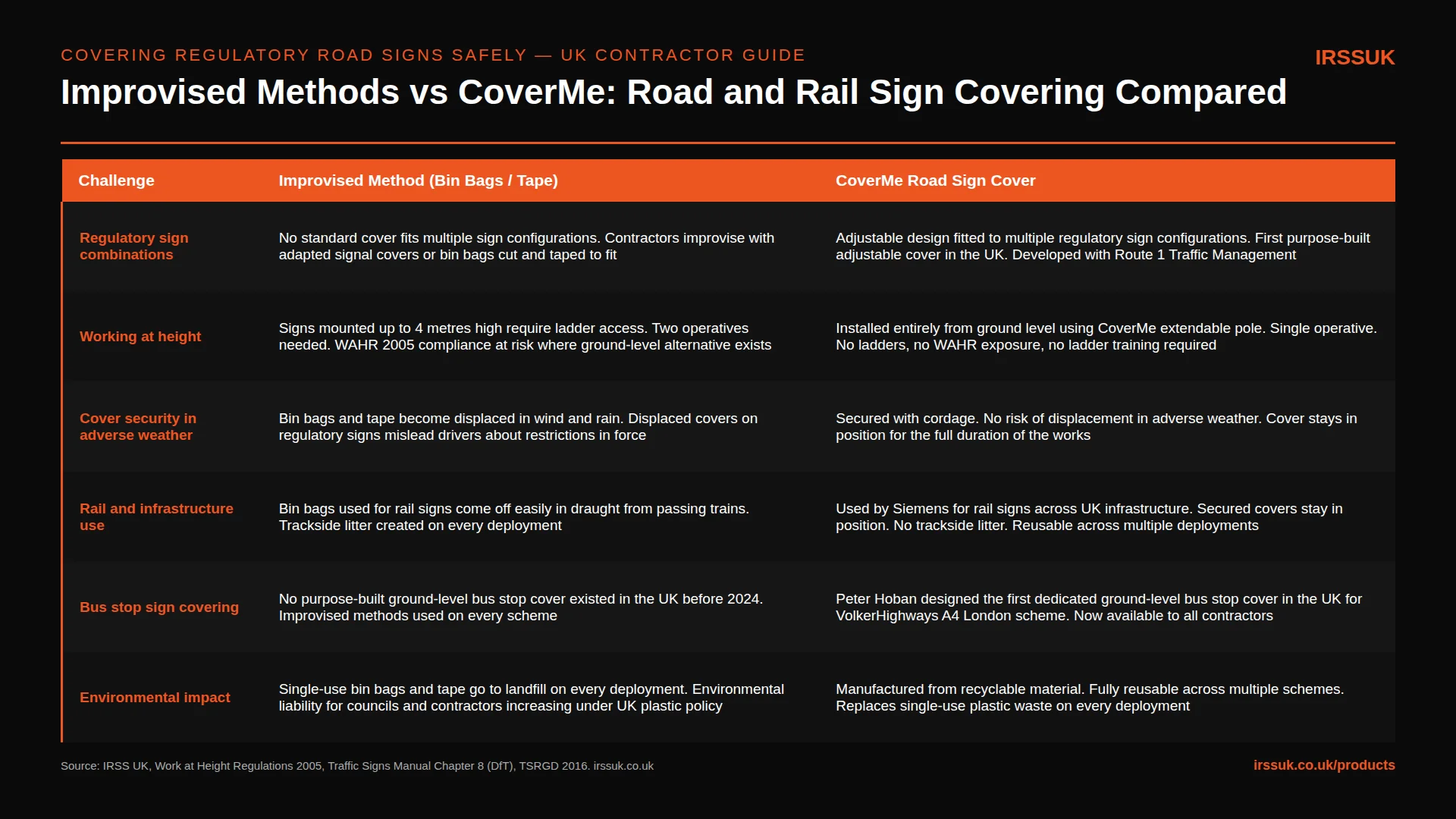
The core challenge is that regulatory sign combinations vary significantly from site to site. A speed limit sign mounted alone requires a different cover to the same sign combined with a no entry restriction, a time limited prohibition, or a pedestrian zone plate. Standard off-the-shelf covers designed for one configuration rarely fit another. Contractors improvised, cutting bin bags to size, using tape that failed in adverse weather, or adapting traffic signal covers that were never designed for road signs.
Bin bags and tape become displaced in wind and rain, leaving regulatory signs uncovered on live road schemes. An uncovered regulatory sign during works can mislead drivers about restrictions that are or are not in force, a direct road safety risk. For rail schemes, the problem is compounded: bin bags used to cover rail signs come off easily in the draught from passing trains, creating trackside litter on every deployment.
The working at height problem was equally persistent. Many regulatory signs are mounted at heights that require ladder access. With no ground-level covering method available, contractors had little choice but to use ladders, accepting the working at height risk even where the WAHR hierarchy required them to avoid it.
How Route 1 Traffic Management Changed Everything
The CoverMe Road Sign Cover was not designed speculatively, it was developed in direct response to a specific request from Route 1 Traffic Management, one of the UK's leading traffic management contractors. Route 1 had already been using CoverMe traffic light covers and recognised that the same ground-level principle needed to be applied to regulatory road signs. They approached Peter Hoban at IRSS UK with a clear brief: there was no professional solution for covering regulatory signs from ground level, and they needed one.
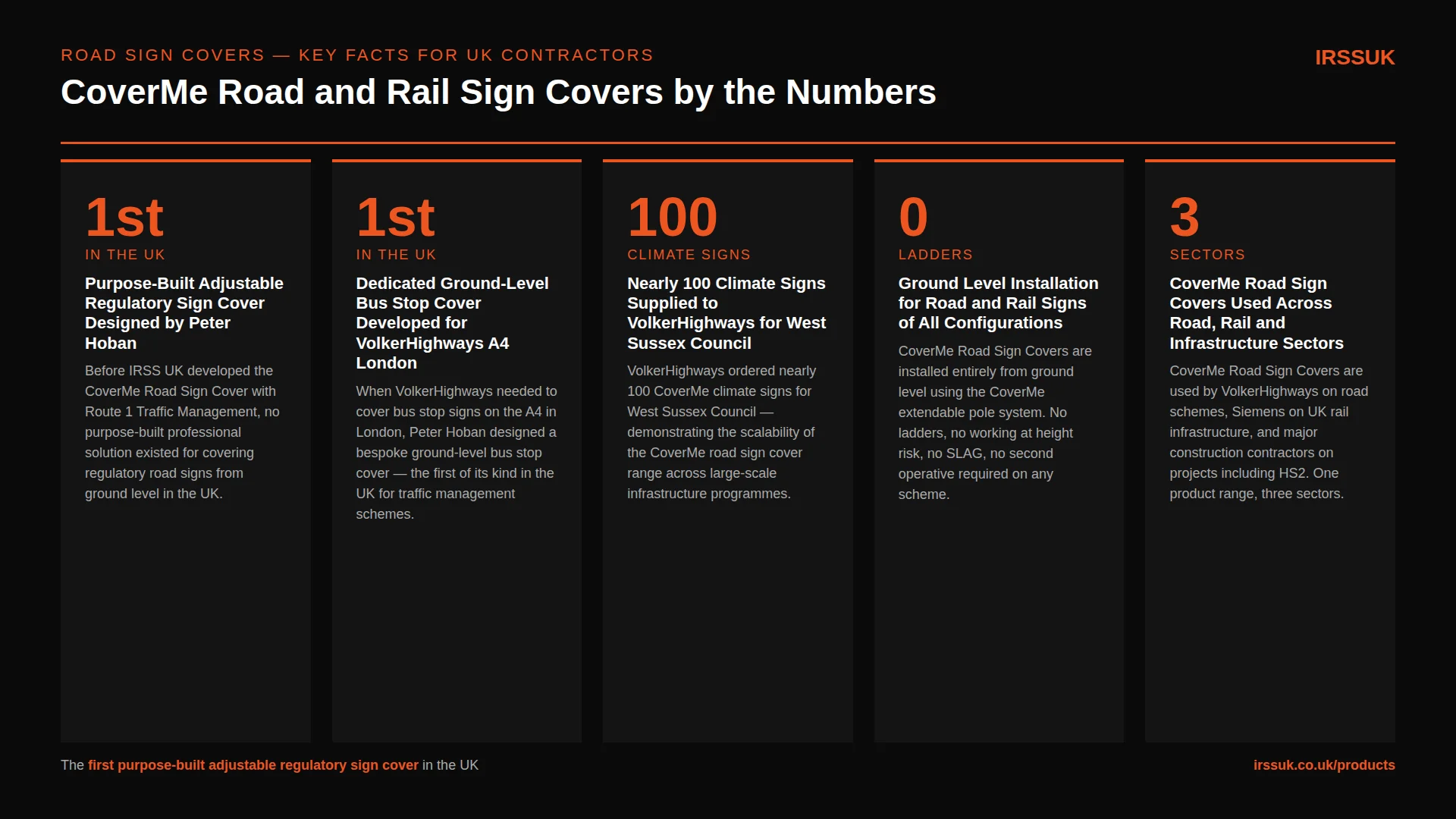
Peter Hoban, inventor and founder of IRSS UK with 25 years of highways industry experience, recognised the design challenge immediately. The difficulty was not simply creating a cover, it was creating a cover that could accommodate the enormous variation in regulatory sign combinations encountered across different sites. The solution was an adjustable design, capable of fitting multiple sign configurations from ground level using the CoverMe extendable pole system. It was the first purpose-built adjustable regulatory road sign cover in the UK.
Bespoke Solutions: The VolkerHighways A4 Bus Stop Cover
The CoverMe Road Sign Cover range does not stop at standard regulatory signs. When VolkerHighways was carrying out works on the A4 in London, the scheme required not only road sign covers but also a dedicated cover for bus stop signs where services were suspended. No purpose-built ground-level bus stop cover existed in the UK at the time.
Peter Hoban designed a bespoke bus stop cover specifically for the VolkerHighways A4 scheme, the first dedicated ground-level bus stop cover in the UK. Installed without ladders by a single operative, the cover provided a professional, compliant solution for a requirement that had previously been met only with improvised methods. VolkerHighways has since taken delivery of nearly 100 CoverMe climate signs for West Sussex Council, demonstrating the range’s versatility across large-scale infrastructure programmes.
Road and Rail: Siemens and the Case for Professional Sign Covers
CoverMe Road Sign Covers are not limited to highway schemes. Siemens uses the CoverMe bagging system for rail signs across UK infrastructure, replacing single-use bin bags that came off easily in the draught from passing trains and created trackside litter. The secured cordage fixing on CoverMe covers ensures they stay in position throughout the works, regardless of weather or passing train movements.
The Siemens rail application highlights a key advantage of the CoverMe system over improvised methods: it was designed to stay in place. Bin bags are not. For rail and infrastructure contractors working to strict safety regimes, a cover that reliably remains in position is not just a convenience, it is a compliance requirement.
Common Questions About Covering Regulatory Road Signs
Is there a legal requirement to cover regulatory road signs during highway works?
Yes. Traffic Signs Manual Chapter 8 requires that all signs are checked to ensure they are covered or removed as appropriate during works. Signs left uncovered when not in use can mislead drivers about restrictions in force, creating a road safety risk and potential liability for the contractor and highway authority. The responsible person for traffic management must ensure compliance throughout the scheme.
Does CoverMe Road Sign Cover fit all regulatory sign combinations?
CoverMe Road Sign Covers are specifically designed to be adjustable, accommodating multiple regulatory sign configurations. This was the core design requirement from Route 1 Traffic Management, regulatory sign combinations vary significantly from site to site, making fixed-size covers impractical. IRSS UK also works with clients to develop bespoke covers for non-standard or unusually configured signs.
Can CoverMe be used for bus stop signs as well as regulatory signs?
Yes. IRSS UK developed a dedicated ground-level bus stop cover for VolkerHighways’ A4 London scheme, the first purpose-built bus stop cover of its kind in the UK. If you have a non-standard sign or street furniture covering requirement, contact IRSS UK to discuss a bespoke solution.
Are CoverMe Road Sign Covers suitable for rail as well as road?
Yes. CoverMe Road Sign Covers are used by Siemens across UK rail infrastructure. The secured cordage fixing ensures covers remain in position in adverse weather conditions and in the draught from passing trains, unlike single-use bin bags which become displaced and create trackside litter.
Do I need ladder training to install CoverMe Road Sign Covers?
No. CoverMe Road Sign Covers are installed entirely from ground level using the CoverMe extendable pole system. No ladder training is required, and operatives from the wider highways pool can deploy covers immediately. This directly addresses the working at height requirement under the Work at Height Regulations 2005.
How are CoverMe Road Sign Covers secured?
CoverMe Road Sign Covers are secured with cordage, ensuring they remain in place throughout the duration of the works regardless of weather conditions. This is a significant improvement over bin bags and tape, which frequently become displaced in wind and rain, leaving signs uncovered on live road schemes.
The Complete Ground-Level Solution for UK Highway Contractors
CoverMe Road Sign Covers are the first purpose-built adjustable regulatory road sign covers in the UK, designed by Peter Hoban of IRSS UK in direct response to a specific industry need, and now used across road, rail, and major infrastructure schemes by contractors including Route 1 Traffic Management, VolkerHighways, and Siemens.
For a full range overview, to request a free sample, or to discuss a bespoke solution for a non-standard sign configuration or application, visit the CoverMe Road Sign Covers page or contact IRSS UK directly.