.svg)
Working at height in traffic management is one of the most persistent causes of serious injury and death in the UK highways sector. Falls from height account for more than 25% of all workplace fatalities nationally, and in the construction and highways sectors, that proportion is significantly higher.
For traffic management operatives, the most common working at height task is one that has gone largely unreformed for three decades: bagging off permanent traffic signals using a ladder. The arrival of ground-level alternatives such as the CoverMe system from IRSS UK, co-developed with ARTSM, now means this risk can be eliminated entirely, and under the Work at Height Regulations 2005, where elimination is reasonably practicable, it is expected.
This guide covers the specific working at height risks in traffic management, the full regulatory framework that applies, and the safer alternatives now available to UK contractors and local authorities.

The Scale of the Problem: Working at Height in the UK
The HSE’s 2024/25 statistics confirm that falls from height remain the leading cause of workplace fatalities in Great Britain, accounting for more than 25% of all worker deaths. Over the five-year period from 2020/21 to 2024/25, falls from height caused an average of 38 deaths per year, consistently the single most common fatal incident type, ahead of being struck by moving vehicles or objects.
In construction, the industry classification that covers most highways and traffic management work, the picture is even more acute. Falls from height have accounted for over half of all construction fatalities across that same five year period, with the sector recording the highest number of worker deaths of any industry in 2024/25. The fatal injury rate in construction is 4.8 times the all industry average.
These are not abstract statistics. They represent operatives on live sites, many in or adjacent to moving traffic, carrying out tasks that feel routine until something goes wrong. The single most effective intervention the HSE and Regulation 6 of the Work at Height Regulations 2005 permit, and require, is elimination: removing the need to work at height entirely.
Working at Height in Traffic Management: Where the Risk Occurs
In traffic management, working at height arises in several contexts. The most frequent and most avoidable is the bagging off of permanent traffic signals when temporary traffic management is being installed.
Bagging off traffic signals requires an operative to climb a ladder to between 4 and 6 metres to place a cover over each signal head. At a typical signalised junction with multiple signal heads across several arms, this process must be repeated many times before temporary lights can be activated. The operative is exposed to moving traffic throughout, the ladder must be set on a carriageway or footway surface, and the task requires manual handling at height on an uneven, potentially wet surface.
Other working at height tasks in traffic management include:
- Installing or removing overhead gantry signs and variable message signs (VMS)
- Maintenance of street lighting associated with road works
- Sign installation on high-mounted poles or bridges
- Accessing signal cabinets at height on elevated infrastructure
Of these, signal bagging is by far the most frequently repeated task — carried out on every site where permanent signals exist and temporary works are required. It is also now the only one of these tasks for which a fully ground-level alternative is commercially available and in widespread use across the UK.

The Regulatory Framework
Multiple pieces of legislation govern working at height in traffic management. Contractors and local authorities operating on UK highways must understand all of them.
Work at Height Regulations 2005
The Work at Height Regulations 2005 are the primary legislation. They apply to any task where a person could fall and suffer injury, regardless of the height involved. The Regulations establish a clear hierarchy of control under Regulation 6:
- Avoid working at height where it is reasonably practicable to do so
- Prevent falls by using collective protection (guardrails, working platforms) where height work cannot be avoided
- Mitigate the distance and consequences of a fall where prevention is not fully achievable
Ladders occupy a specific and restricted position in this hierarchy. Under HSE guidance, a ladder should only be used where a risk assessment has demonstrated that equipment offering a higher level of protection is not justified. The phrase not justified is significant: it places the burden on the employer to show why a safer alternative was not used, not on the regulator to show why it should have been.
For signal bagging, where a ground-level system now exists and is in active use across the UK, using a ladder when a contractor is aware of the alternative may be very difficult to justify under a risk assessment.

Construction (Design and Management) Regulations 2015
CDM 2015 applies to highways and traffic management works. The Traffic Management designer is explicitly a Designer under CDM, carrying a duty to eliminate or reduce foreseeable risks through design decisions. Principal contractors have a duty under Regulation 13 to plan, manage and monitor the construction phase, including working at height activities, and to ensure risks are reduced so far as is reasonably practicable.
The ARTSM Guidance on the Use of Portable Traffic Signals (GUPS) confirms that the Traffic Management designer acts as a Designer under CDM Regulations 2015, meaning methodology decisions including how signals are bagged are part of the design duty, not merely an operative’s choice on the day.
The Health and Safety at Work Act 1974
The Health and Safety at Work Act 1974 imposes a general duty on employers to ensure the health, safety and welfare of employees so far as is reasonably practicable. This duty underpins the specific Regulations above and is the basis for HSE enforcement action, which can result in unlimited fines and, in cases of gross negligence, custodial sentences for individuals.
Safety at Street Works and Road Works, The Red Book
The Red Book, with legal backing under Sections 65 and 124 of the New Roads and Street Works Act 1991, sets out the statutory requirements for signing, lighting and guarding at road works. Failure to comply is evidence of failing to fulfil legal requirements. Its requirement that work must not start until the correct equipment is in place applies equally to the bagging off of signals: permanent signals must be covered before temporary systems are activated, and the method used must comply with the full regulatory framework above.
ARTSM Guidance on Bagging and Switch Off
IRSS UK played a direct role in developing ARTSM’s national guidance on bagging and switch-off of signals. That guidance confirms that when signals are not in operation for any significant period, they must be bagged, and that the process must be approached with the working at height regulatory framework in mind. The method of bagging — whether a ladder or ground-level system is used, is a risk management decision, not an operational preference.
Why the Ladder Has Persisted and Why That Is Changing
For over 30 years, the ladder-and-bin-bag method was the only available approach to bagging off signal heads. Contractors and local authorities used it not because it was safe, but because there was nothing else. The task was accepted as an unavoidable working at height activity, managed by training and risk assessment rather than eliminated.

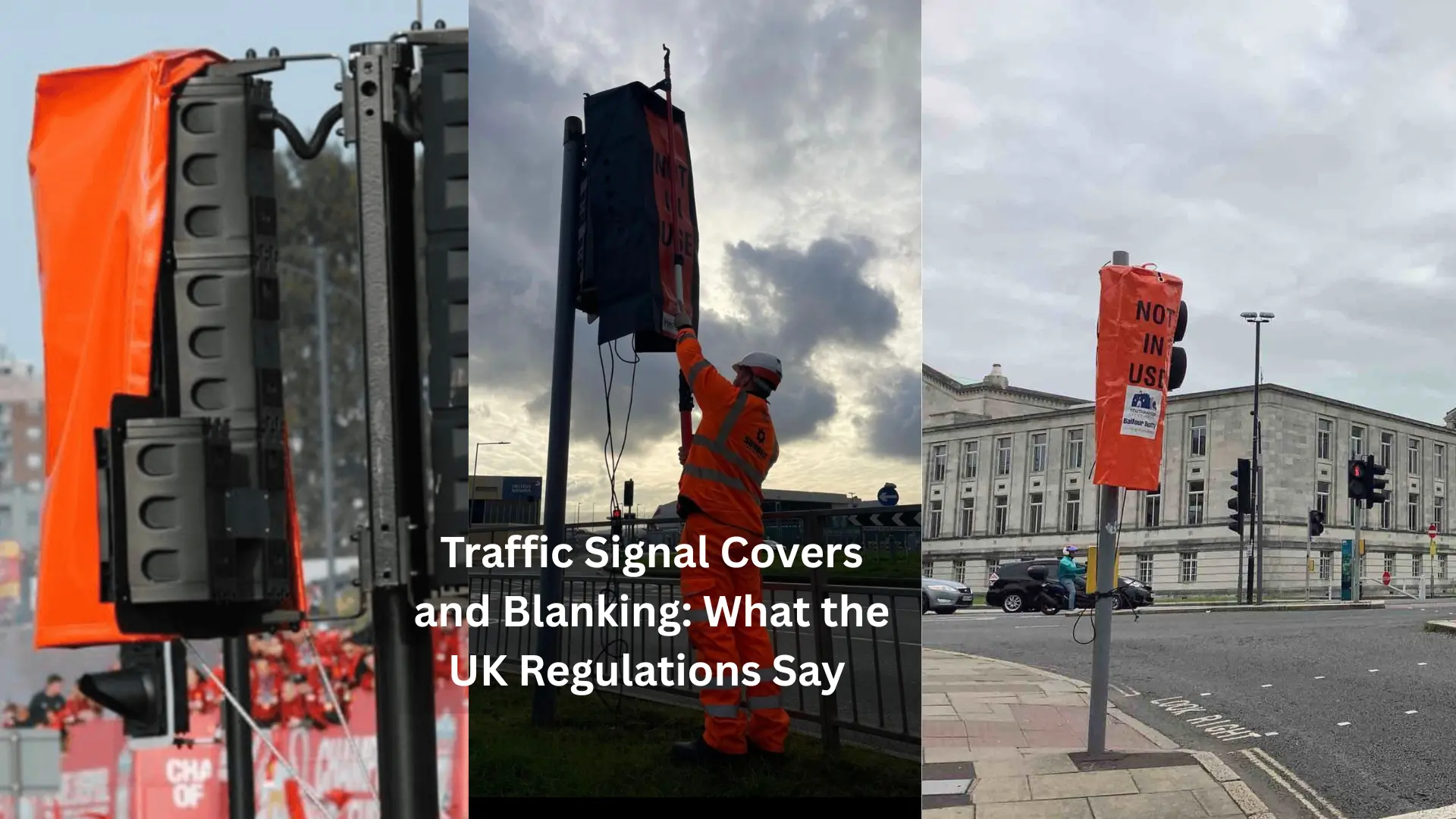
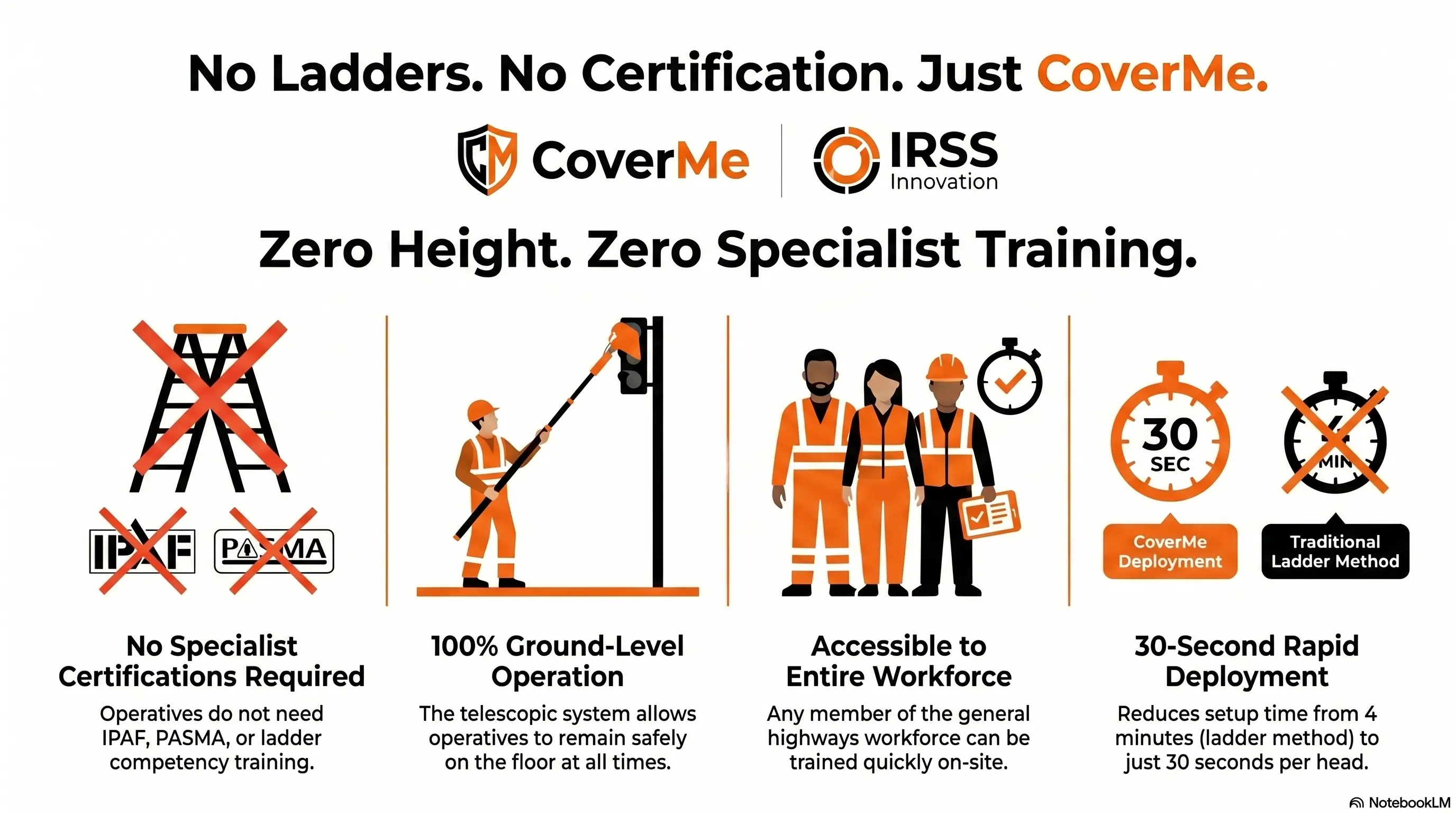
The introduction of the CoverMe system by IRSS UK changed this fundamentally. The system uses a purpose-built high-visibility PVC cover installed via an extension pole from ground level. Each signal head is covered in approximately 30 seconds. No ladder is required at any stage. The cover is secured at a purpose-engineered locking point and removed using the same pole, also from ground level.
This is not a workaround or a compromise. It is a purpose-designed, patented system that eliminates working at height for signal bagging entirely, the highest level of control in the Regulation 6 hierarchy.
The system has been adopted by SRL Traffic Systems as part of their exclusive switching service, deployed by Colas Group on the City Connect 3 project in Leeds (bagging 12 permanent signals with zero working at height), by Siemens for rail sign coverage, and by operators across the UK and Republic of Ireland. IRSS is also a member of ARTSM, the industry body whose guidance now shapes national best practice on signal decommissioning.
Safer Alternatives to Ladder Based Signal Bagging
For traffic management contractors and local authorities reviewing their working at height risk profile, the options for signal decommissioning have changed materially.
Ground-level cover systems (CoverMe): The only patented, purpose-designed system for bagging off traffic signal heads from the ground. Eliminates working at height entirely. No specialist ladder training required. Any operative from the highways pool can use it. Covers are reusable, recyclable, and high-visibility.
Switching services with trained operatives: SRL Traffic Systems offer a combined switching and bagging service using CoverMe, removing the need for a separate signal engineer to attend site. This eliminates both the working at height risk and the coordination delay caused by waiting for specialist resource.
Bin bags with ladders (not recommended): The traditional method, now carrying significant regulatory risk. Where a contractor knows a ground-level alternative exists and chooses not to use it, the risk assessment justification for using a ladder becomes very difficult to sustain. This is no longer simply a cost or convenience question, it is a legal exposure question.
Common Questions
Does the Work at Height Regulations 2005 apply to bagging off traffic signals?
Yes. Any task where an operative could fall and suffer injury is covered, regardless of the height involved. Bagging off signal heads at 4 to 6 metres is clearly within scope. Regulation 6 requires employers to first consider whether working at height can be avoided, and where a ground-level alternative is available, using a ladder instead is increasingly difficult to justify.

Who is responsible for working at height risk in traffic management, the operative or the employer?
The primary duty lies with the employer and those who control work at height, including principal contractors and Traffic Management designers acting under CDM 2015. The operative has a duty to follow the safe system of work provided, but the system itself must be designed to eliminate or reduce risk at the planning stage, not simply managed by the operative on site.
Is there a legal requirement to use ground-level bagging systems for traffic signals?
There is no specific legal mandate naming any product. However, the Work at Height Regulations 2005 require employers to avoid working at height where it is reasonably practicable. Where a ground-level system is commercially available, competitively priced, and in widespread use, a risk assessment that fails to consider it, and opts for a ladder instead, may be difficult to defend in the event of an incident or HSE investigation.
What are the penalties for non-compliance with working at height regulations in highway works?
Under the Health and Safety at Work Act 1974, companies face unlimited fines. Individual directors and managers can face up to two years’ imprisonment where the breach involves their consent, neglect or involvement. HSE enforcement action following a working at height incident on a highways site will examine the risk assessment, the alternatives considered, and whether reasonably practicable controls were implemented.
Building a Compliant Working at Height Risk Assessment for Traffic Management
For any traffic management operation involving permanent signal decommissioning, a compliant risk assessment should address:
- Whether working at height can be avoided entirely for each task (Regulation 6, step 1)
- What ground-level alternatives were considered and why, if not adopted
- The specific height, surface conditions, and traffic exposure at the bagging location
- The competence and training of the operative undertaking the task
- The method of securing and stabilising any ladder if height work is unavoidable
- The rescue and emergency plan in the event of a fall
For signal bagging specifically, any risk assessment completed after the CoverMe system became commercially available should document the consideration of ground-level alternatives. Omitting this is not a neutral choice, it is a gap that HSE investigators and insurers will notice.
The Future Direction of Traffic Management Safety
The industry trajectory is clear. ARTSM’s involvement in developing national guidance on bagging and switch-off, combined with the active adoption of ground-level systems by major operators, is establishing a new baseline expectation. What was once accepted as unavoidable is now, demonstrably, avoidable.
For local authorities specifying traffic management contracts, requiring ground-level signal bagging as a contract condition is a straightforward and defensible procurement decision. For traffic management companies building their health and safety management systems, documenting the adoption of CoverMe or equivalent ground-level systems is an audit-ready demonstration of Regulation 6 compliance.
Peter Hoban, founder of IRSS UK and a 25-year veteran of the highways industry, developed CoverMe precisely because the industry’s acceptance of ladder-based bagging had gone unchallenged for too long. The system exists because the risk was real, the alternative was achievable, and the regulatory expectation, eliminate first, was not being met.
Summary: Key Takeaways for Highways Contractors and Local Authorities
- Falls from height are the leading cause of workplace fatalities in the UK, consistently responsible for over 25% of all worker deaths annually
- Working at height in traffic management arises most frequently during bagging off of permanent traffic signals — a task historically performed at 4 to 6 metres using a ladder
- The Work at Height Regulations 2005 require elimination of working at height as the first priority; CDM 2015 places this duty on designers and principal contractors from the planning stage
- ARTSM national guidance on signal bagging , IRSS UK were part of the group involved, requires that signals are bagged when not in use and that the regulatory framework governs how that is done
- The CoverMe system eliminates working at height for signal bagging entirely, installing each head in 30 seconds from ground level with no ladder required
- Choosing a ladder for signal bagging when a ground-level alternative is known and available is a risk management decision that requires active justification under the Regulation 6 hierarchy
For more information on the CoverMe ground-level bagging system, or to discuss your site requirements, contact IRSS UK or explore the CoverMe product range.