.svg)
The Work at Height Regulations 2005 apply to every UK traffic management operative who installs, adjusts, or removes equipment beside a live carriageway. They are not construction regulations. They are not office safety rules. They apply whenever there is a risk of injury from a fall, regardless of how high off the ground the task takes place. For traffic operatives bagging off permanent signal heads, they apply directly and without exception.
What the regulations actually say
The Work at Height Regulations 2005 were introduced under the Health and Safety at Work etc. Act 1974. They replaced a fragmented set of earlier rules and established a single, clear legal framework for any work where a person could fall a distance liable to cause injury. The previous threshold of 2 metres no longer applies. If a fall could injure someone, the regulations apply.
Regulation 6 is the one every traffic operative and traffic management company needs to understand. Every employer shall ensure that work is not carried out at height where it is reasonably practicable to carry out the work safely otherwise than at height. This is a legal duty. The starting point for every task involving potential height work is the question: can this be done from the ground?
Regulation 7 goes further. It requires employers to select and use equipment that either prevents or minimises the potential for a fall. The selection of equipment must be based on a genuine assessment of what is reasonably practicable, taking into account the nature of the task and the availability of safer alternatives.
Check out our full guide on Safer Alternatives to Ladder Work in Traffic Management
The hierarchy of control in plain English
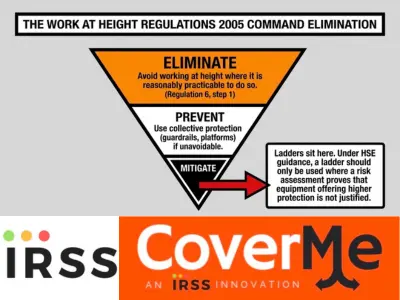
The regulations establish a three-level hierarchy of control that determines how height risk must be managed on every site. Understanding this hierarchy is the difference between a compliant method statement and one that would not survive scrutiny after an incident.
The first level is avoidance. If the task can be done from the ground, it must be done from the ground. Cost is not a valid reason to skip this step. Habit is not a valid reason. Time pressure is not a valid reason. The law requires avoidance wherever it is reasonably practicable, and the existence of a commercially available ground-level alternative makes it very difficult to argue that avoidance is not practicable.
The second level is prevention. Where height work cannot be avoided, the employer must prevent falls using collective protection: scaffolding, edge guardrails, or permanent platforms with barriers. Personal protective equipment such as harnesses comes last, not first.
The third level is mitigation. Where a fall cannot be fully prevented, the distance and consequences must be minimised using soft landing systems, harness systems with appropriate anchor points, and rescue plans that can recover a suspended worker in minutes.
What this means for bagging off traffic signals
Bagging off permanent signal heads is one of the most common tasks in UK traffic management that involves working at height. On most UK signal installations, the signal head sits at between 4 and 6 metres. Reaching it using a traditional ladder beside a live carriageway satisfies none of the three levels of the hierarchy effectively.
It does not avoid height risk. It does not prevent a fall through collective protection. It places the operative at height with no edge protection beside live traffic passing within metres of the ladder base.
For the full regulatory context on bagging off requirements, including Chapter 6 of the Traffic Signs Manual 2019 and ARTSM guidance, see our complete guide to traffic light covers and bagging-off solutions.
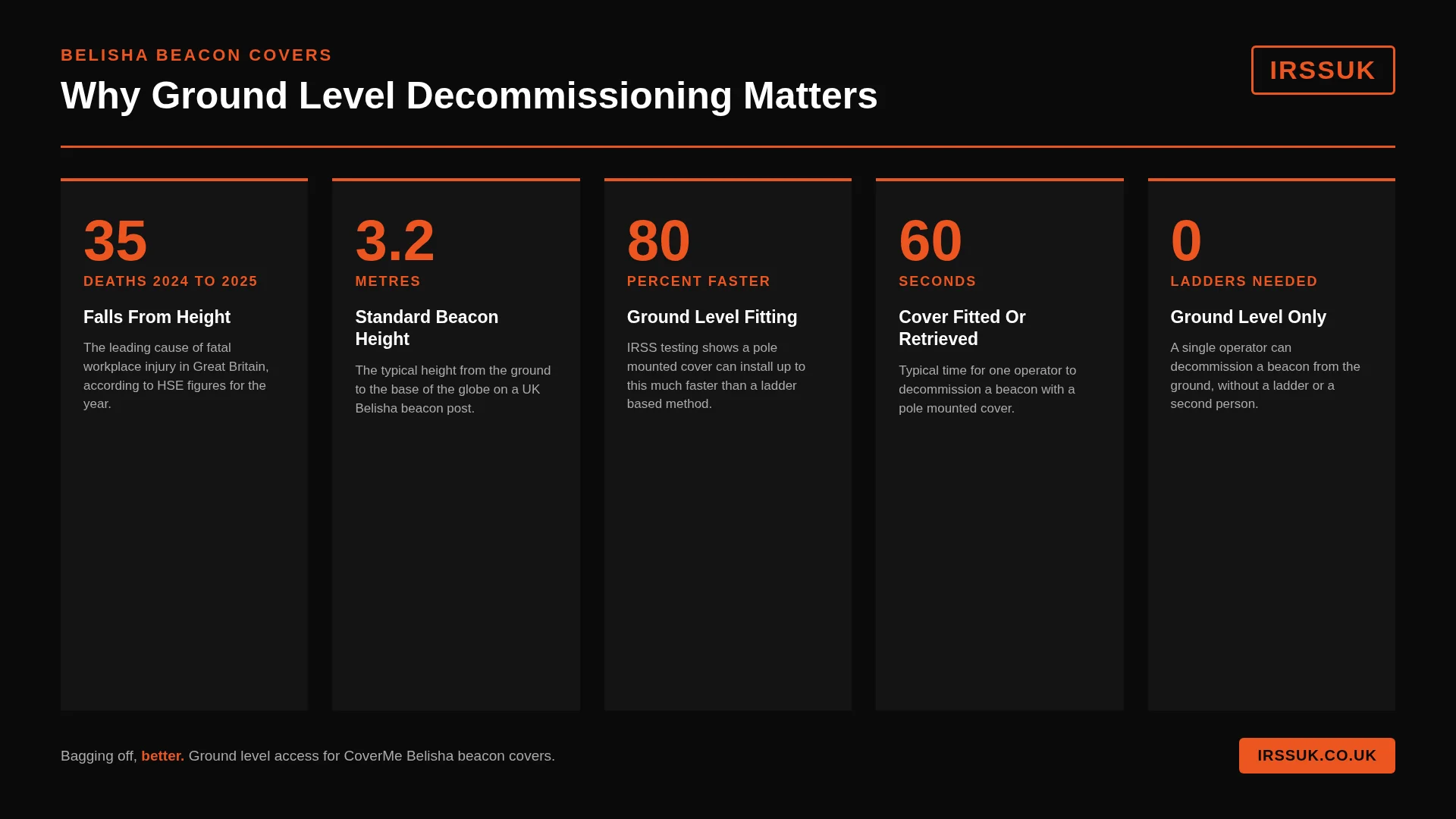
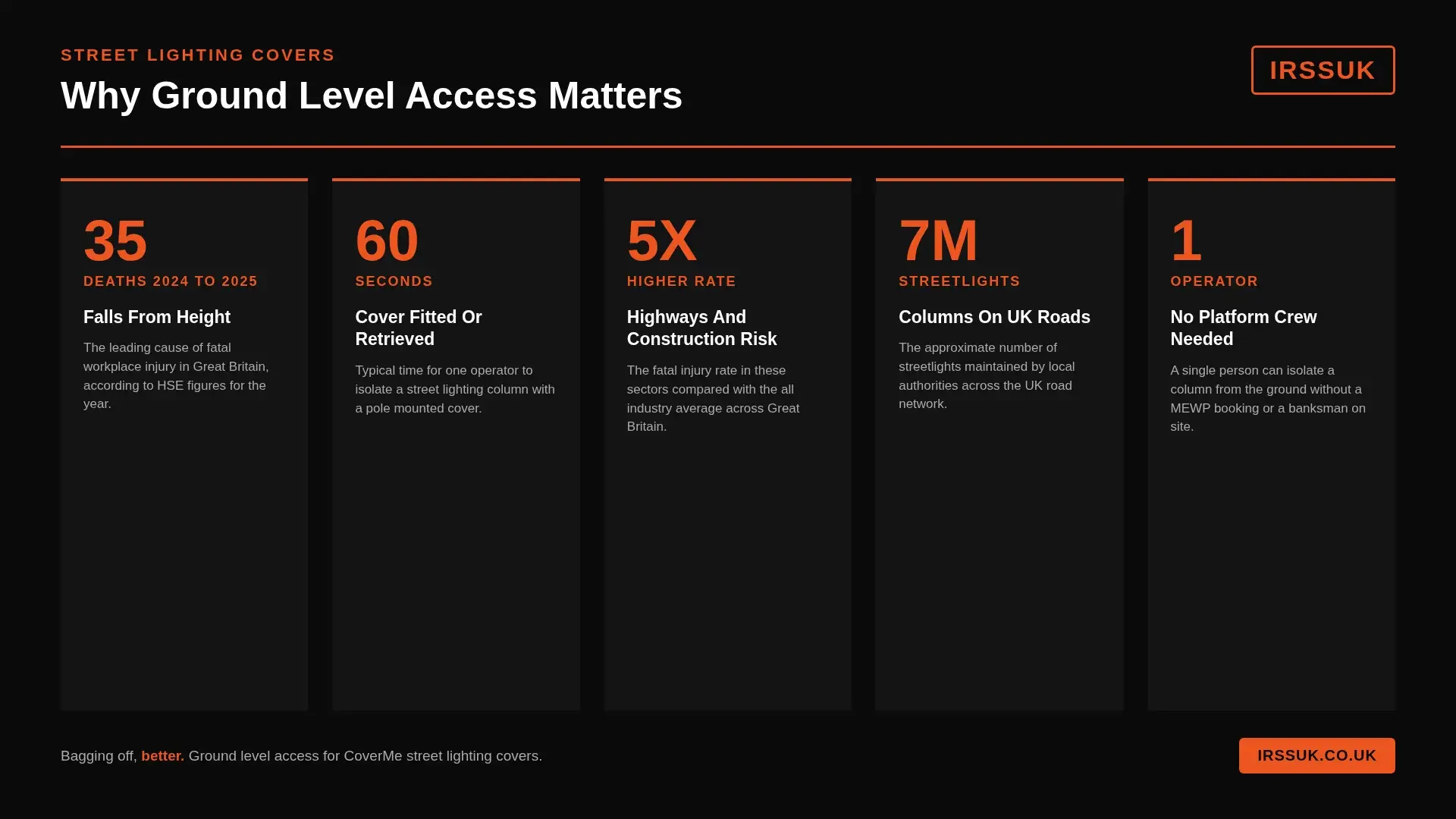
The Health and Safety Executive reports that falls from height caused 35 worker deaths in 2024/25, the leading cause of fatal workplace injury in Great Britain for over 20 years. In construction and highways environments, the risk is compounded by roadside conditions and live traffic.

The ground-level alternative and what the law expects
CoverMe traffic light covers from IRSS UK were designed specifically to satisfy the first level of the hierarchy for bagging off operations. The system uses a patented extension pole that allows a single operative to fit a purpose-made opaque PVC cover over a signal head from a standing position on the ground. No ladder. No MEWP. No IPAF certification required.
When a system like this exists and is commercially available, the legal question becomes straightforward. Is it reasonably practicable to use it? The answer, on any standard scheme with standard UK signal heads, is yes. A method statement that defaults to ladder use when a ground-level alternative is available and proven is not compliant with Regulation 6.
Peter Hoban, founder of IRSS UK, developed CoverMe after 25 years in the traffic management industry. He co-authored the ARTSM national best practice guidance on bagging off traffic signals. The system reduces signal head covering time from approximately 3 minutes per head to around 30 seconds, while eliminating height risk at the first level of the hierarchy.
Use the CoverMe calculator to see how many covers your next scheme needs.
Duties on employers, designers, and operatives
The Work at Height Regulations 2005 place duties on employers, not just operatives. Every employer who controls or organises work at height must ensure the work is properly planned, appropriately supervised, and carried out by competent people using suitable equipment. Competence under the regulations means the operative has the training and experience to carry out the specific task safely. A certificate alone does not prove competence.
CDM Regulations 2015 add a further duty at the design stage. The Traffic Management Designer must eliminate foreseeable risks so far as reasonably practicable. Where bagging off is required on a scheme, specifying a ground-level method in the method statement satisfies this duty before operatives arrive on site.
Common questions about WAH Regulations for traffic operatives
Do the Work at Height Regulations 2005 apply at any height, or only above 2 metres?
They apply at any height where a fall could cause injury. The previous 2 metre threshold no longer exists. For traffic operatives bagging off signal heads at 4 to 6 metres, the regulations apply fully.
Can a traffic management company use a ladder for bagging off if it is in the risk assessment?
Including ladder use in a risk assessment does not make it compliant with the regulations. Regulation 6 requires avoidance first. If a ground-level alternative is reasonably practicable, ladder use is not compliant regardless of what the risk assessment states.
What does competence mean under WAH Regulations 2005 for traffic operatives?
Competence means the operative has the training and experience to carry out the specific task safely. For ground-level bagging off using the CoverMe system, no ladder or IPAF certification is required.
Is a MEWP always safer than a ladder for bagging off?
A MEWP is generally safer than a ladder, but both sit below avoidance in the hierarchy of control. If a ground-level system is available and reasonably practicable, both the MEWP and the ladder should be superseded by it.
What should a traffic operative do if asked to use a ladder when a ground-level system is available?
Under the Work at Height Regulations, operatives have a duty to report any situation they reasonably believe presents a risk to themselves or others. The regulations place the primary duty on the employer, but operatives are not absolved of responsibility for their own safety.
The key takeaway
The Work at Height Regulations 2005 do not ask traffic management companies to be braver or more careful on ladders. They ask whether the ladder is necessary at all. For bagging off traffic signals, the answer is no. A ground-level system exists, it is commercially available, it is used on live UK highway schemes every day, and the law expects it to be used. Speak to the IRSS UK team to discuss how CoverMe can be specified into your next scheme.
About the author: Peter Hoban is the founder of IRSS UK and inventor of the patented CoverMe system. With over 25 years of experience in traffic management and road safety, Peter co-authored the ARTSM national best practice guidance on bagging off traffic signals. He is a Safer Highways Big Idea finalist and a recognised authority on working-at-height elimination in the highways industry.