.svg)
Street lighting covers let highways crews isolate a lit column without a ladder, cherry picker, or MEWP, by fitting a ground level bag over the lantern head using an extendable pole.
IRSS UK, who advised as part of the ARTSM national guidance on bagging and switch off, developed the CoverMe system specifically to remove work at height risk from routine street lighting and traffic signal isolation work.
What Street Lighting Covers Do
A street lighting cover is a weatherproof bag, deployed and retrieved with a telescopic pole, that fits over a column mounted lantern to indicate it is out of service or to physically block its light output.
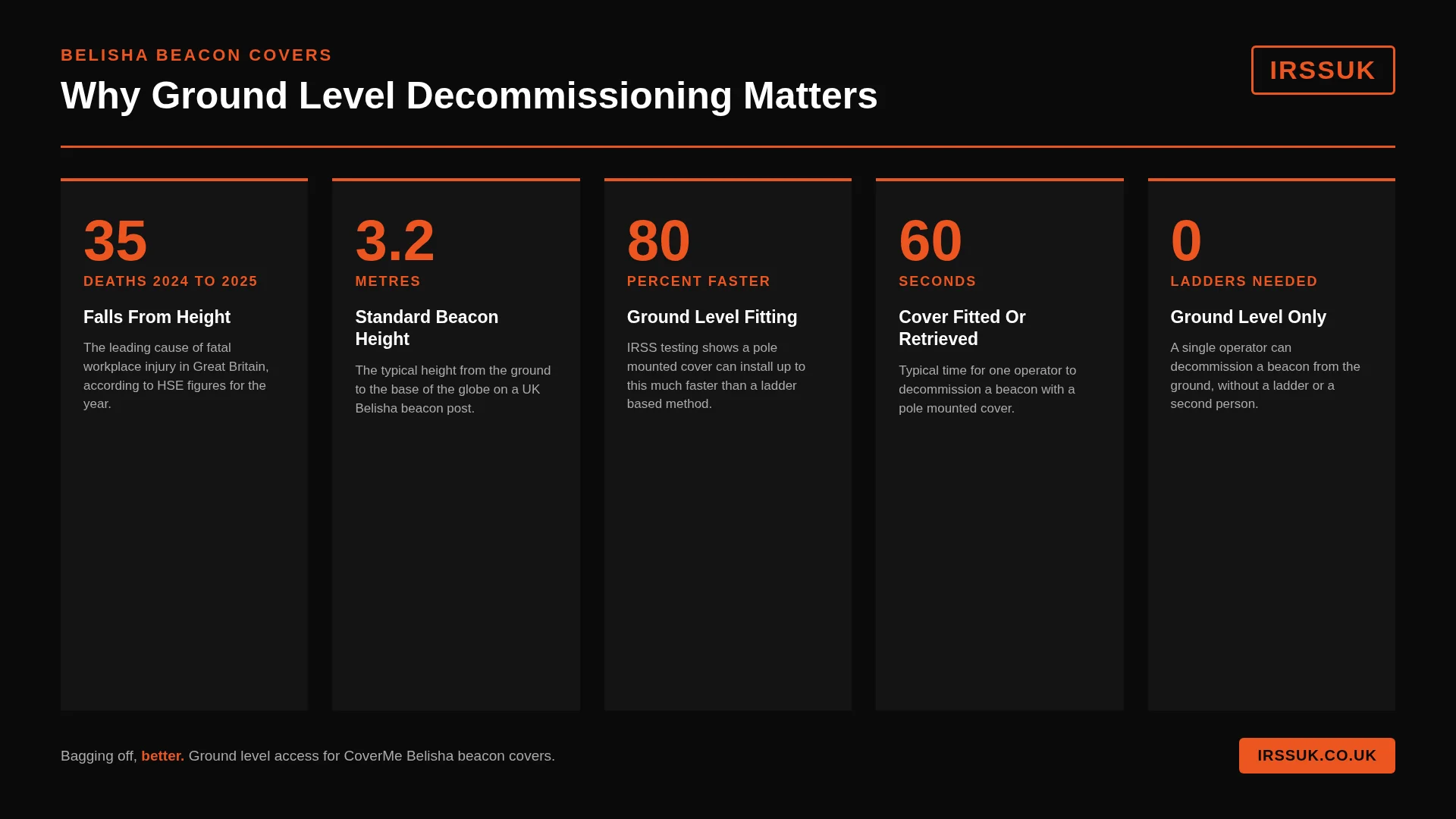
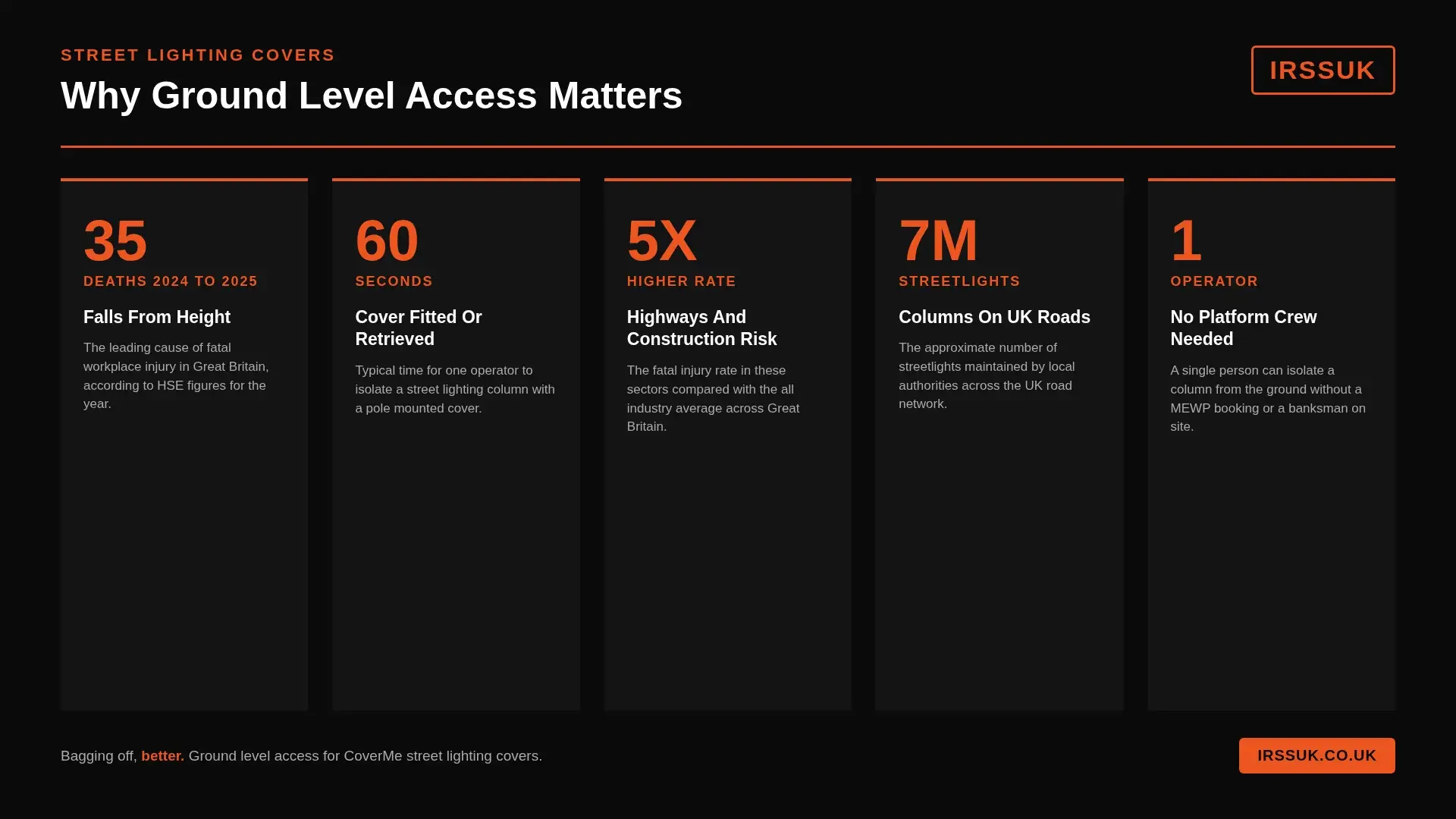
The operator stays on the ground throughout. There is no ladder pitch, no MEWP booking, and no second person required for a stepladder foot hold. Falls from height caused 35 worker deaths in Great Britain in 2024/25, the single largest cause of fatal workplace injury, according to HSE.
Removing the need to climb removes that risk category entirely for this task.
UK Regulations and Standards Context
The Work at Height Regulations 2005 set a clear hierarchy: avoid work at height wherever possible, prevent falls where it cannot be avoided, and minimise the consequences where prevention isn't fully achievable.
A ground level covering method satisfies the first and most preferred step in that hierarchy, rather than relying on fall arrest equipment or platform training further down the list.
For traffic signal and street furniture bagging specifically, ARTSM's guidance on bagging and switch-off of signals sets the sector benchmark that IRSS UK helped advise on, and the same isolate without climbing principle applies directly to street lighting columns on live highway schemes.
How CoverMe Works in Practice
The CoverMe pole system extends to reach standard column heights, with a quick release head that seats the cover over the lantern and locks it in place. Retrieval uses the same pole in reverse.
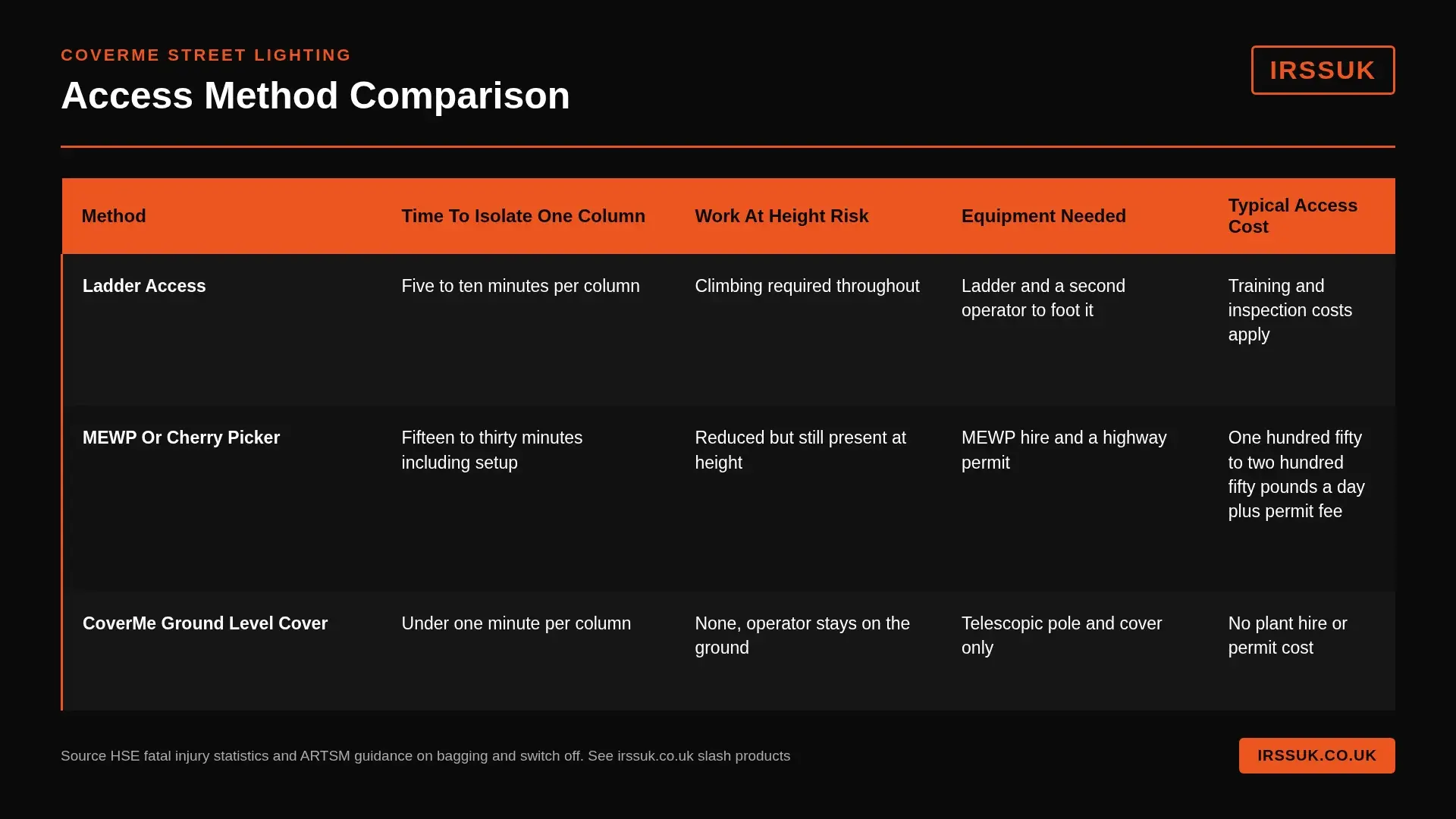
A single operator can isolate a column in under a minute without setting up an exclusion zone for a MEWP or arranging a second banksman. On multi column schemes, such as a lighting upgrade or a temporary signal installation running alongside street lighting works, this turns what would be a MEWP and permit job into a walk the route task.
Local authority MEWP permits for highway work commonly carry their own charges and lead time on top of hire costs, both of which disappear when the column can be covered from the ground.
For a broader look at how the same ground level principle applies across traffic signals, road signs, and other street furniture, see our complete guide to traffic light covers and bagging off solutions.
The full CoverMe street lighting covers range covers the standard column and lantern types used across UK highway networks.
Common Questions
Q: What is a street lighting cover used for?
A: A street lighting cover isolates a column mounted lantern from ground level, either to show it is out of service during maintenance or works, or to block its light output where a temporary signal or diversion needs to take priority. It replaces climbing the column to physically disconnect or shield the light.
Q: Do you still need a MEWP for street lighting maintenance?
A: Not for isolation or bagging off. A telescopic pole system reaches standard column heights from the ground, so a MEWP is only needed for tasks that require hands on access to the lantern itself, such as a lamp change or internal repair.
Q: Is ladder access to street lighting columns still permitted under UK regulations?
A: The Work at Height Regulations 2005 require avoiding work at height wherever a practical alternative exists, before considering fall prevention or mitigation measures.
Where a ground level method achieves the same outcome, such as isolating a column, it should be the first option considered, not a fall arrest or ladder based approach.
Q: How long does it take to bag off a street lighting column?
A: With a pole mounted cover system, a trained operator can fit or retrieve a cover in under a minute per column, compared with the setup, exclusion zone, and stand down time a MEWP or ladder access typically requires.
Why Getting This Right Matters
With over 7 million streetlights across the UK's road network, even a small reduction in per column access time and risk compounds quickly across a maintenance contract or a multi site scheme.
Falls from height remain the leading cause of workplace fatalities in Great Britain, and construction and highways work carries a fatal injury rate roughly five times the all industry average. A method that removes the climb removes the exposure, not just the paperwork around it.
The Bottom Line
Street lighting covers move column isolation from a working at height task to a ground level one, cutting both risk and turnaround time without needing a MEWP booking or ladder training sign off. For crews running signal and lighting works together, that consistency matters as much as the safety case. Get in touch with IRSS UK to talk through fitting CoverMe street lighting covers into your next scheme.