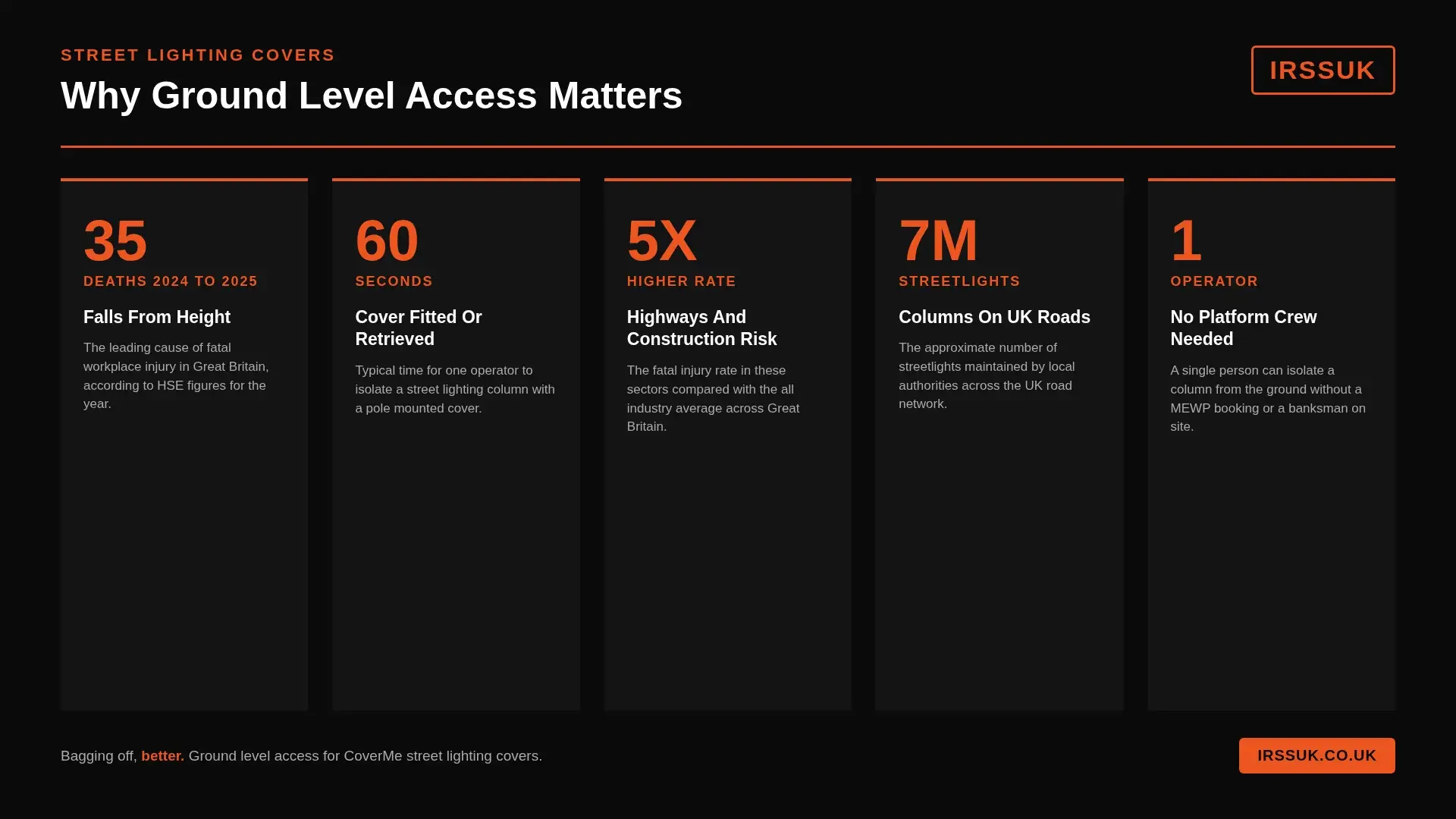
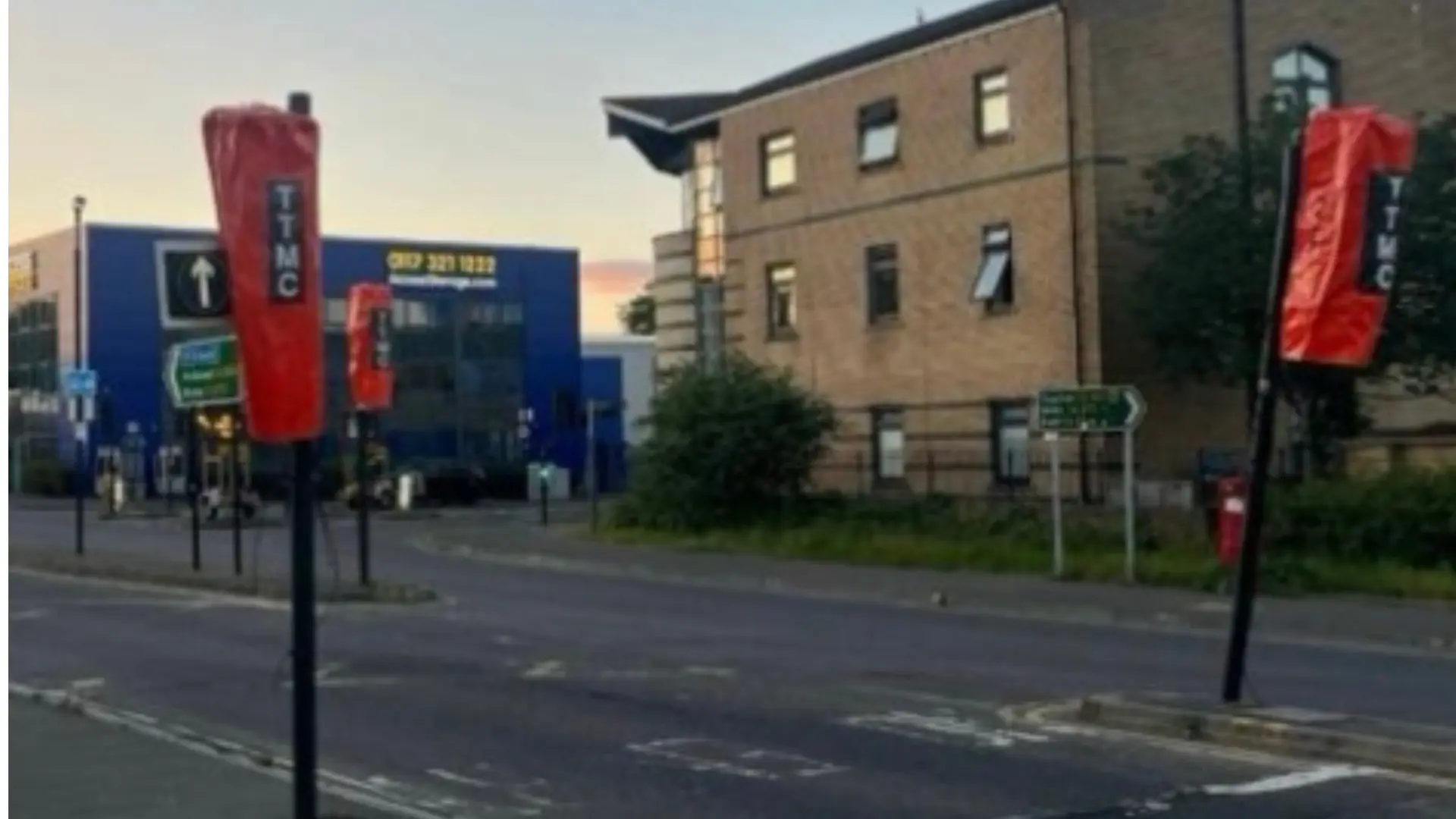
.svg)
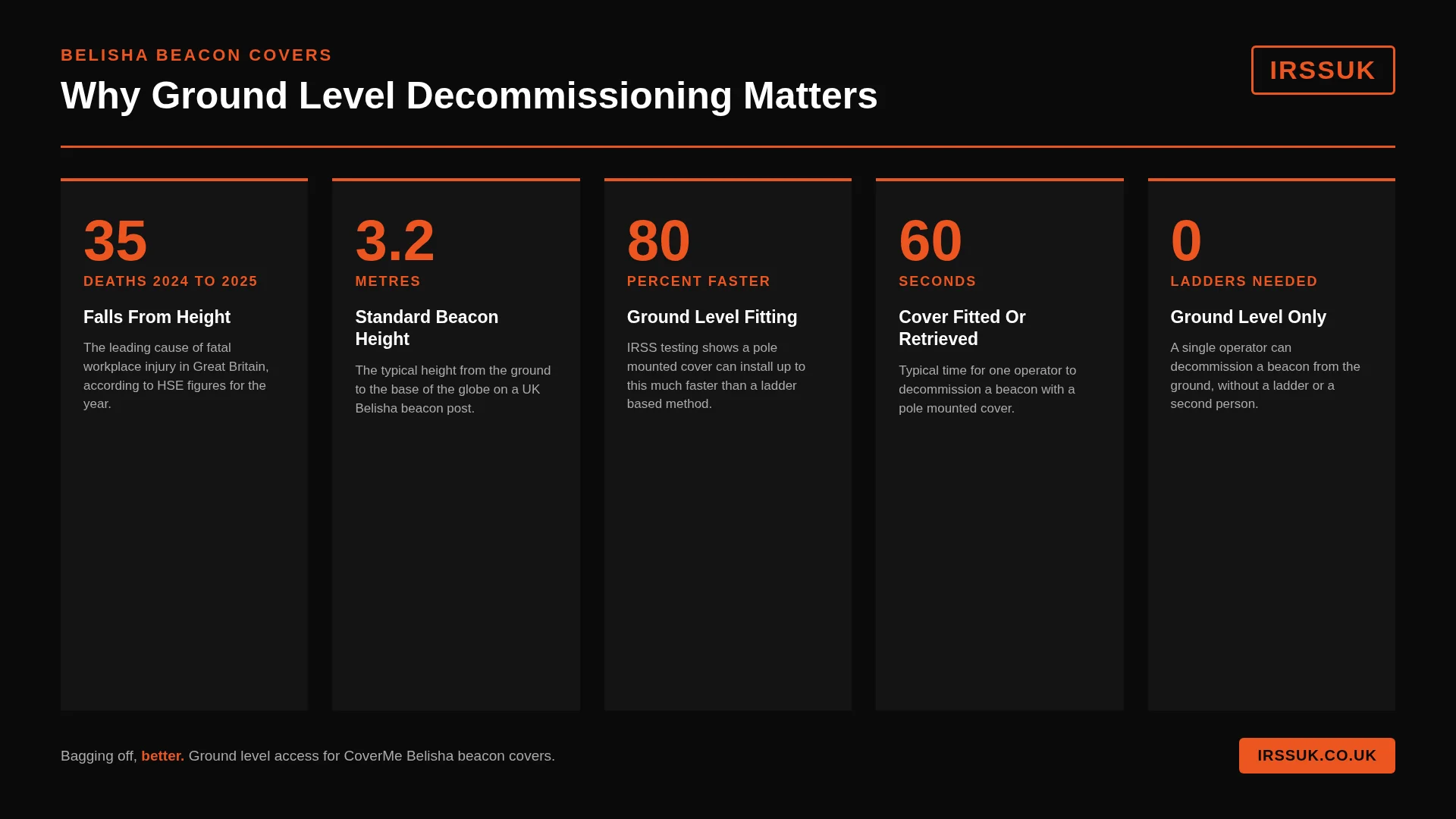
Belisha beacon covers let highways crews decommission a zebra crossing beacon from ground level, using a pole mounted cover instead of a ladder against a 3.2 metre pole.
IRSS UK, co-authors of the ARTSM national guidance on bagging and switch-off, built the CoverMe system to take the same ground level principle used on traffic signals and apply it to beacon decommissioning and temporary crossing works.
What Belisha Beacon Covers Do
A Belisha beacon cover is a weatherproof bag, fitted and retrieved with a telescopic pole, that fits over the globe at the top of the beacon post to show it is decommissioned or temporarily out of use.
The operator does not need to climb the post or use a ladder to reach the globe.
Falls from height caused 35 worker deaths in Great Britain in 2024/25, the largest single cause of fatal workplace injury according to HSE, and beacon decommissioning work has historically relied on exactly the ladder access that drives that figure.
UK Regulations and Standards Context
Every zebra crossing in Great Britain requires a Belisha beacon at each end under the Zebra Pedestrian Crossings Regulations, with the beacon's globe and internal illumination specified under the Traffic Signs Regulations and General Directions 2016.
When a crossing is decommissioned, upgraded to a signal controlled crossing, or temporarily taken out of use for nearby works, the beacon itself still needs to be dealt with safely rather than left live or climbed to disconnect.
ARTSM's guidance on bagging and switch-off of signals, which IRSS UK helped author, sets out the same avoid the climb principle that applies directly to beacon decommissioning on live highway schemes.
How CoverMe Works in Practice
The CoverMe pole system extends to reach the beacon globe at standard post height, with a quick release head that seats the cover in place and locks it, then retrieves it the same way.
A single operator can decommission a beacon in under a minute without a ladder, a second person to foot it, or a MEWP booking.
IRSS UK has applied the same ground level method at scale on live signal decommissioning schemes, including bagging 12 permanent signal heads on the City Connect 3 project in Leeds with zero working at height, and the company's own testing puts a pole mounted cover at up to 80% faster to install than a ladder based method.
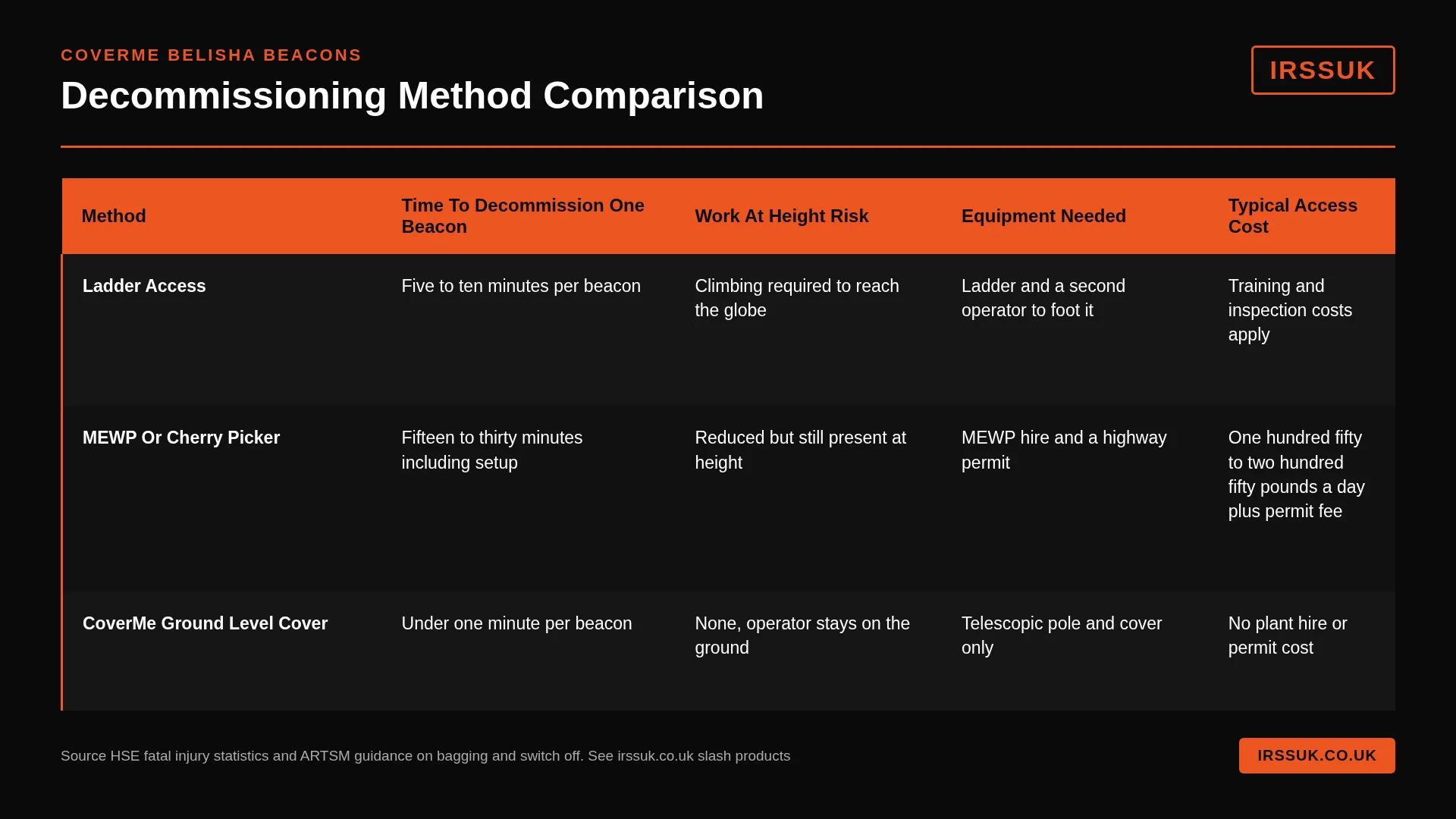
For crews handling a full crossing removal or downgrade, that speed matters across every beacon on the scheme, not just the one being photographed for the safety file.
See our complete guide to traffic light covers and bagging off solutions for how the same approach applies across signals, road signs, and street furniture, and the full CoverMe Belisha beacon covers range for the beacon specific fitting.
Common Questions
Q: What is a Belisha beacon cover used for?
A: A Belisha beacon cover fits over the globe at the top of a beacon post to show it has been decommissioned or is temporarily out of use, without needing to climb the post to disconnect or physically remove it.
Q: How tall is a Belisha beacon post?
A: A standard Belisha beacon post is around 3.2 metres from the ground to the base of the globe, which is high enough to require a ladder or platform for hands on access under traditional methods.
Q: Do you need a ladder to decommission a Belisha beacon?
A: Not with a pole mounted cover system. A telescopic pole reaches the globe from the ground, so a ladder is only needed for tasks that require physically removing or replacing the beacon hardware itself.
Q: Why can't a Belisha beacon just be switched off and left in place?
A: Under the Zebra Pedestrian Crossings Regulations, an unbagged, unlit beacon at a crossing can confuse drivers and pedestrians about whether the crossing is still in use. Covering the globe gives a clear, unambiguous signal that the crossing has changed status.
Why Getting This Right Matters
Crossing removals and upgrades typically involve more than one beacon, plus the associated signage and, in many schemes, nearby street lighting or signal works running at the same time.
Falls from height remain the leading cause of fatal workplace injury in Great Britain, and a scheme that requires a ladder at every beacon on a multi crossing job multiplies that exposure across the site. A ground level method removes the climb at each point, not just the first one.
The Bottom Line
Belisha beacon covers turn decommissioning from a ladder job into a ground level one, cutting risk and time across every beacon on a crossing removal or upgrade scheme.
For contractors already using ground level covers on traffic signals, extending the same method to beacons keeps the whole crew working the same way, on every asset type. Get in touch with IRSS UK to talk through fitting CoverMe Belisha beacon covers into your next scheme.